Integrated DC Servo Motors Vs. Stepper Motors for Precision Seeding Applications
Views: 0 Author: Site Editor Publish Time: 2026-10-22 Origin: Site
Precision seeding is a critical function in modern agricultural machinery, directly influencing seed spacing, planting depth, crop uniformity, and overall field productivity. As agricultural equipment manufacturers develop smarter planting systems, the demand for accurate, reliable, and responsive motor-driven seed metering mechanisms continues to increase. Selecting the right motor technology is essential for achieving consistent planting performance under changing operating conditions.
Integrated DC servo motors and stepper motors are two widely used motion control solutions for precision seeding applications. Both technologies can provide controlled positioning and rotational movement, but they differ in feedback capabilities, torque characteristics, dynamic response, system integration, and performance under variable loads.
For agricultural machinery manufacturers, OEMs, and precision agriculture system integrators, understanding these differences helps determine which motor solution best meets specific planting requirements. In this article, we examine how integrated DC servo motors compare with stepper motors for precision seeding, focusing on positioning accuracy, seed metering consistency, operating efficiency, environmental durability, and system integration.
1. Understanding Motor Requirements for Precision Seeding Systems
Precision seeding systems regulate the delivery of individual seeds or controlled seed quantities at predetermined intervals. Depending on the equipment design, the motor may drive a seed metering disc, singulation mechanism, seed dispensing roller, or variable-rate planting assembly.
Unlike conventional agricultural drives that primarily require continuous rotation, precision seeding mechanisms must coordinate motor speed and movement with ground speed, planting density, and seed placement requirements.
Several technical factors determine motor suitability.
1.1 Seed Spacing Accuracy
Consistent seed spacing helps reduce gaps and overcrowding within crop rows. The motor must maintain a predictable relationship between its rotational movement and the number of seeds released by the metering mechanism.
Speed fluctuations, mechanical backlash, excessive vibration, and missed motion commands can contribute to uneven seed distribution. A motor with appropriate control characteristics helps maintain stable metering performance, particularly when the planting speed changes.
1.2 Dynamic Response to Changing Field Conditions
Agricultural machinery rarely operates under perfectly constant conditions. Tractor acceleration, uneven terrain, changes in planting speed, and variations in mechanical resistance can affect the load on a seed metering drive.
The selected motor must respond quickly to commanded speed changes while maintaining the required torque. This is particularly important in variable-rate seeding systems, where seed delivery must adjust according to prescription maps, crop requirements, or real-time control signals.
1.3 Continuous Operation and Environmental Resistance
Planting equipment may operate for extended periods in dusty, humid, and vibration-intensive environments. Motor selection must therefore account for operating temperature, enclosure protection, electrical reliability, bearing life, and resistance to mechanical shock.
In addition to performance, manufacturers should evaluate maintenance requirements, installation space, wiring complexity, and total system cost.
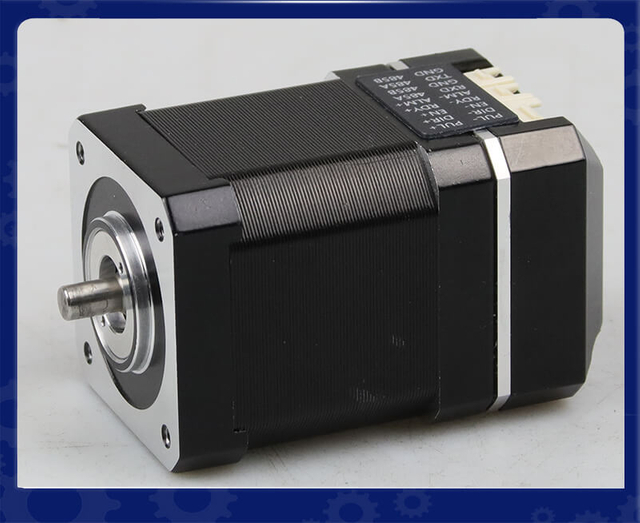
An integrated DC servo motor combines a DC motor, feedback device, and electronic drive or controller within a compact assembly. Depending on the product architecture, the unit may also include current sensing, communication interfaces, configurable control modes, and protection functions.
This integrated design reduces the need to install a separate motor, servo drive, and associated feedback wiring as independent components.
For precision seeding equipment, integrated DC servo motors offer a practical approach to controlling seed metering speed and position while reducing the complexity of the electrical system.
2.1 Closed-Loop Motion Control
A principal advantage of servo technology is its ability to use feedback to regulate motor operation. An encoder or another suitable feedback device measures actual motor movement, allowing the controller to compare the measured response with the commanded target.
When a disturbance causes the motor to deviate from its target speed or position, the control system can adjust motor current and torque to correct the error within its operating limits.
This closed-loop approach is valuable when the seed metering mechanism experiences changing resistance or when the system must follow frequent speed commands.
However, the actual positioning accuracy depends on encoder resolution, controller tuning, transmission design, mechanical compliance, and the relationship between motor movement and seed release.
2.2 Stable Speed Regulation for Seed Metering
In a motor-driven seed metering assembly, the motor must rotate at a speed that corresponds to the desired planting density and machine travel speed.
Integrated DC servo motors can regulate rotational speed using feedback, helping compensate for load disturbances and speed changes. This capability is particularly useful when planting equipment must maintain consistent seed delivery across a broad operating range.
For example, when a planter accelerates at the beginning of a field pass, the controller can increase motor speed according to the required seed spacing. During deceleration, the motor can reduce speed to prevent excessive seed delivery.
The control system must also account for communication delays, mechanical response, seed transport time, and the actual release characteristics of the metering mechanism.
2.3 Compact Installation and Reduced Wiring Complexity
Integrated servo motors consolidate several motion control components into one assembly. This can simplify electrical cabinet design, reduce interconnecting cables, and make modular planting units easier to install.
For agricultural machinery manufacturers developing multi-row planters, compact integrated drives can support standardized row-unit designs and simplify equipment assembly.
The exact integration benefits depend on the motor's communication interfaces, power requirements, connector arrangement, and compatibility with the machine's control architecture.
3. What Are Stepper Motors?
A stepper motor converts electrical pulse commands into discrete angular movements. Each input pulse corresponds to a specified movement increment determined by the motor's step angle and the selected drive mode.
This operating principle makes stepper motors suitable for applications requiring repeatable incremental motion without necessarily requiring a feedback encoder.
In precision seeding systems, stepper motors may drive metering discs, dispensing rollers, adjustment mechanisms, and other components that operate at relatively predictable speeds and loads.
3.1 Open-Loop Position Control
A conventional open-loop stepper system calculates motor movement from the number of commanded pulses. For example, a controller can command a defined number of pulses to rotate a seed metering disc through a specified angle.
This approach can simplify system architecture because a separate position feedback device is not always required.
However, the controller generally cannot confirm that every commanded step has been completed unless additional feedback or monitoring is implemented. Excessive load, rapid acceleration, insufficient torque, or mechanical obstruction can cause missed steps.
If missed steps occur without detection, the actual metering position may differ from the commanded position, potentially affecting seed delivery.
3.2 Holding Torque and Low-Speed Performance
Stepper motors can provide useful holding torque at standstill when appropriately energized. This characteristic can benefit mechanisms that require a stable position during setup or adjustment.
Nevertheless, stepper motor torque generally decreases as rotational speed increases, with the actual torque-speed curve depending on motor inductance, supply voltage, drive current, and drive electronics.
For precision seed metering, manufacturers must verify that sufficient torque remains available at the maximum required operating speed and during acceleration.
3.3 Microstepping and Motion Smoothness
Microstepping divides each full motor step into smaller commanded current increments. This can improve motion smoothness and reduce vibration compared with full-step operation.
However, microstep resolution should not be confused with equivalent absolute positioning accuracy. Actual shaft position depends on load torque, motor characteristics, drive current regulation, and mechanical conditions.
For seed metering mechanisms sensitive to vibration, a properly configured microstepping drive can help reduce mechanical disturbance and improve low-speed operation.
3.4 Closed-Loop Stepper Alternatives
Not all stepper systems are open-loop. Closed-loop stepper motors use feedback to monitor position and may correct errors when the actual motion differs from the command.
These systems can improve reliability under variable loads while retaining stepper motor characteristics. Consequently, a meaningful comparison should distinguish conventional open-loop stepper motors from closed-loop stepper systems rather than treating all stepper solutions as identical.
4. Integrated DC Servo Motors vs. Stepper Motors: Key Differences
The most suitable motor depends on the required control performance, load profile, planting speed, environmental conditions, and system budget.
Comparison Factor
Integrated DC Servo Motor
Conventional Open-Loop Stepper Motor
Motion control
Closed-loop feedback control
Pulse-based control without inherent position verification
Position correction
Can correct detected motion errors within system limits
Cannot inherently detect or correct missed steps
Speed regulation
Feedback-based speed regulation
Speed determined by pulse frequency and motor response
Dynamic response
Generally suitable for rapid speed and load changes when properly sized
Performance depends on torque-speed characteristics and acceleration limits
Torque at higher speeds
Depends on motor rating, voltage, and drive limits
Torque typically decreases significantly as speed increases
Holding performance
Depends on servo design and control mode
Can provide strong holding torque when energized
Energy consumption
Varies with load and control strategy
Can consume substantial current even at standstill
System integration
May consolidate the motor, encoder, and drive
May require a separate drive; feedback is optional
Control complexity
Requires feedback configuration and appropriate tuning
Basic open-loop operation can be comparatively simple
Typical cost considerations
Higher initial cost may be offset by integration and performance benefits
Often attractive for cost-sensitive, predictable motion tasks
These differences describe common system architectures, not universal performance guarantees. Integrated servo products vary in feedback resolution, current capacity, communication protocols, and control features. Stepper systems also vary considerably depending on whether they use open-loop, closed-loop, or advanced current-control technology.
5.Why Agricultural Machine Manufacturers Choose Integrated DC Servo Motors
Modern agricultural machinery is evolving toward higher automation, greater operational efficiency, and more precise control. From precision seeders and fertilizer applicators to autonomous agricultural robots and intelligent spraying systems, manufacturers increasingly require motion control solutions that deliver accurate positioning, stable speed regulation, reliable operation, and simplified system integration.
Integrated DC servo motors are becoming an important motion control solution for agricultural machine manufacturers because they combine a motor, feedback device, and drive electronics in a compact assembly. Compared with conventional motor systems that require separate drivers and additional wiring, integrated servo motors can simplify installation, reduce control system complexity, and support more responsive motion control.
For original equipment manufacturers (OEMs), selecting the right motor technology is not only about achieving the required torque and speed. It also involves reducing development time, improving machine reliability, managing environmental challenges, and controlling the total cost of ownership.
In this article, we explore why agricultural machine manufacturers choose integrated DC servo motors, how these motors support modern agricultural applications, and which technical factors should be considered when selecting a suitable solution.
5.1 Simplified System Integration and Reduced Wiring Complexity
One of the main reasons agricultural machinery manufacturers choose integrated DC servo motors is their compact, all-in-one design.
A conventional servo system typically requires a separate motor, servo drive, feedback wiring, and associated control connections. In comparison, an integrated DC servo motor combines several of these components into a single unit, reducing the number of separately installed devices.
For agricultural equipment manufacturers, this integrated architecture offers several practical advantages.
Reduced Electrical Installation Work
By integrating the motor and drive electronics, manufacturers can simplify electrical cabinet layouts and reduce the number of interconnecting cables. Depending on the model, integrated servo motors may also support direct communication with the machine's main controller.
This can make installation more straightforward, particularly for agricultural machinery with multiple independently controlled actuators.
Compact Equipment Design
Space is often limited in modern agricultural machinery. Seed metering units, fertilizer dispensing mechanisms, and robotic implements must accommodate motors, sensors, transmission components, and protective housings within restricted mounting areas.
An integrated servo motor can reduce the space required for separately mounted drive electronics, helping engineers develop more compact and modular machine designs.
Faster OEM Development
Integrated motor solutions can reduce the number of components that engineers must select, mount, wire, and configure independently. This may simplify prototyping, shorten commissioning time, and improve consistency across repeated machine designs.
For manufacturers producing several equipment models with similar motion control requirements, standardized integrated servo assemblies can also simplify engineering and production processes.
5.2 Higher Motion Control Accuracy for Precision Agriculture
Precision agriculture requires agricultural machinery to perform specific operations at controlled speeds and positions. Whether a planter regulates seed spacing or a fertilizer applicator adjusts material delivery, accurate motor control directly affects operational consistency.
Integrated DC servo motors typically use encoder feedback to monitor actual motor movement and compare it with commanded motion. The controller can then adjust motor output to reduce detected speed or position errors within the system's operating limits.
Accurate Seed Metering and Consistent Planting
In precision seeding equipment, a motor may drive a seed metering disc or another seed dispensing mechanism. The motor must maintain a controlled rotational speed corresponding to the target seed spacing and the machine's ground speed.
An integrated servo motor can regulate metering speed as planting conditions change. This is particularly useful when the machine accelerates, decelerates, or changes its planting rate.
By maintaining more consistent metering motion, the system can help reduce speed-related variation in seed delivery. However, actual seed placement accuracy also depends on seed singulation, metering design, transmission backlash, seed tube geometry, and ground-speed measurement.
Precise Fertilizer Dispensing
Fertilizer application systems often require controlled material delivery according to crop requirements, field conditions, or prescription maps.
Integrated servo motors can regulate the speed of dispensing rollers, augers, and other metering mechanisms. When the target application rate changes, the controller can adjust motor speed to support the required material flow.
The final application accuracy depends on the relationship between motor rotation and material output, as well as fertilizer properties, mechanical design, and calibration.
Repeatable Actuator Positioning
Beyond continuous rotation, integrated servo motors can support repeatable positioning in mechanisms such as adjustable planting components, automated implement controls, and robotic agricultural equipment.
Feedback-based positioning helps the controller identify deviations between commanded and measured motion, improving control consistency when the system is properly sized and configured.
5.3 Responsive Performance Under Changing Agricultural Loads
Agricultural machinery rarely operates under completely stable conditions. Soil resistance, mechanical friction, seed accumulation, material flow, and operating speed can all affect the load placed on a motor.
An integrated DC servo motor can respond to these disturbances by adjusting its output according to feedback from the motor and drive system.
Dynamic Speed Regulation
When a seed metering mechanism experiences increased resistance, the motor may tend to slow down. A closed-loop servo controller can detect the resulting speed error and increase motor output when sufficient torque and current capacity are available.
This helps maintain the commanded operating speed under changing loads.
Fast Acceleration and Deceleration
Modern agricultural machinery increasingly uses variable-rate control. For example, a precision planter may need to adjust its seed metering rate as the tractor changes speed or as the machine enters a different field zone.
Integrated servo motors can execute changing speed commands with controlled acceleration and deceleration, provided their torque, speed, and control bandwidth are suitable for the application.
Improved Motion Tracking
In applications requiring frequent speed changes or coordinated actuator movement, feedback-based control can help the motor follow its commanded trajectory more consistently.
This capability is valuable for intelligent agricultural machinery in which the motor must respond to commands from sensors, electronic controllers, or field management systems.
5.4 Support for Variable-Rate Seeding and Fertilization
Variable-rate application is an important feature of precision agriculture. Instead of applying a uniform quantity of seed or fertilizer across an entire field, the machine adjusts its output according to crop requirements and field-specific data.
Integrated DC servo motors can support this approach by controlling the speed of individual metering mechanisms.
Adjustable Seed Delivery Rates
For a seed metering system, the required seed delivery rate is related to the desired seed spacing and the machine's ground speed.
When ground speed increases, the metering mechanism generally needs to deliver seeds at a higher rate to maintain the same spacing. When the target planting density changes, the controller must adjust the required metering rate accordingly.
An integrated servo motor can execute these speed commands while using feedback to monitor actual motor movement.
Precision Fertilizer Application
In variable-rate fertilizer systems, the controller may calculate the target dispensing rate using GPS positioning, field prescription data, or sensor measurements.
The integrated servo motor then regulates the dispensing mechanism according to the commanded rate. The system must also account for material flow characteristics, response delays, and calibration factors.
Independent Control of Multiple Row Units
Agricultural machinery manufacturers may equip each planting row or dispensing unit with an independent motor. This architecture allows the controller to adjust individual units according to machine configuration and application requirements.
When supported by the selected communication interface and control system, integrated servo motors can help simplify the development of modular, independently controlled agricultural equipment.
5.5 Compact Design for Modern Agricultural Machinery
As agricultural equipment becomes more automated, manufacturers must fit additional sensors, controllers, actuators, and communication components into increasingly compact machine structures.
Integrated DC servo motors help address this challenge by combining multiple motion control components into a single assembly.
Reduced Installation Space
Integrating the drive electronics with the motor can reduce the space required for separate servo drives and associated mounting hardware.
This can be particularly beneficial for row-based planting systems, compact fertilizer applicators, agricultural robots, and automated implement adjustment mechanisms.
Modular Equipment Architecture
Integrated servo motors can support modular machine designs in which individual actuators are installed as standardized assemblies.
For OEMs, this may simplify product development, component replacement, and the adaptation of an existing machine platform to different operating requirements.
Flexible Equipment Configuration
Depending on the available models, manufacturers can select integrated servo motors with different power ratings, encoder configurations, communication interfaces, and mechanical mounting options.
The selected specifications should match the machine's torque, speed, installation, and environmental requirements rather than relying on compact size alone.
5.6 Communication Capabilities for Intelligent Agricultural Equipment
Modern agricultural machines depend on communication between motors, sensors, controllers, and monitoring systems. Reliable command transmission and status feedback are essential for coordinated operation.
Integrated DC servo motors may support several communication options, depending on the product design.
Common interfaces include:
Pulse and direction: Suitable for systems that command motor movement through electrical pulses.
CANopen: Useful for networked motion control and communication with compatible controllers.
Modbus RTU: Commonly used for parameter configuration, status monitoring, and control in compatible systems.
EtherCAT: Suitable for applications requiring high-speed industrial communication and coordinated motion, when supported by the motor and machine architecture.
Not every integrated servo motor supports all these interfaces. Manufacturers should verify protocol compatibility, command update rates, diagnostic capabilities, and controller integration requirements before selecting a model.
Centralized Monitoring and Diagnostics
When the motor supports suitable feedback and communication functions, the machine controller may be able to monitor operating speed, position, current, temperature, and fault status.
This information can help maintenance personnel identify abnormal operating conditions and reduce troubleshooting time.
Coordination Across Multiple Actuators
In multi-row planters and automated agricultural systems, multiple motors may need to respond to coordinated commands.
A suitable communication architecture helps manage these commands and provides a structured method for monitoring each actuator. Actual synchronization performance depends on the selected protocol, controller, network configuration, and motion control implementation.
5.7 Environmental Protection for Dusty and Moist Agricultural Conditions
Agricultural machinery frequently operates in dusty fields and may encounter moisture, mud, vibration, and temperature fluctuations. Motor reliability therefore depends on both the motor design and its suitability for the installation environment.
IP65 Protection for Agricultural Applications
Some integrated DC servo motors are available with IP65-rated enclosures. Under the applicable test conditions, IP65 indicates that the enclosure is dust-tight and protected against water jets.
This protection level can be suitable for certain outdoor agricultural installations, provided the complete motor assembly is correctly mounted and its connectors, cable glands, and seals maintain the required protection.
However, IP65 does not automatically guarantee resistance to prolonged immersion, every pressure-washing condition, corrosive chemicals, or all forms of mechanical damage.
Manufacturers should evaluate the actual exposure conditions and select an enclosure rating appropriate to the application.
Vibration and Mechanical Durability
Agricultural equipment may experience continuous vibration from engines, wheels, soil contact, and working implements.
To support reliable operation, the motor's mounting structure, bearings, connectors, and cables must withstand the expected mechanical stresses.
Correct mounting and alignment also help reduce unnecessary loads on the output shaft and transmission.
Operating Temperature Considerations
Motor and drive electronics must remain within their specified temperature limits during continuous operation and under peak loads.
Before production approval, manufacturers should evaluate temperature rise under representative ambient conditions, mounting arrangements, duty cycles, and electrical loads.
Environmental suitability should be verified through application-specific testing rather than inferred solely from the motor's enclosure rating.
5.8 Improved Fault Monitoring and Operational Reliability
Unexpected motor failures can interrupt planting, fertilizer application, or other agricultural operations. Integrated DC servo motors can support improved fault monitoring when their drive electronics provide suitable protection and diagnostic functions.
Depending on the model, available functions may include overcurrent protection, overvoltage protection, undervoltage detection, overtemperature protection, stall detection, and communication fault reporting.
Early Identification of Abnormal Operating Conditions
Feedback data and drive alarms can help the machine controller identify deviations from expected motor operation.
For example, an increase in current demand may indicate higher mechanical resistance, while a tracking error may indicate that the motor cannot follow the commanded movement.
These signals do not automatically identify the root cause, but they can help maintenance personnel investigate problems before they lead to extended downtime.
Controlled Fault Responses
When a fault occurs, the motor and machine controller should respond according to the system's defined control strategy.
Depending on the application, the response may involve stopping the motor, limiting output, reporting an alarm, or requiring an operator reset.
For agricultural machinery, the machine-level response is especially important. A stopped seed metering motor may cause a planting gap, so the system should detect the fault and handle it appropriately.
Simplified Troubleshooting
Integrating the motor and drive can reduce the number of separate components that technicians must inspect. When diagnostic information is available, troubleshooting may also become more systematic.
However, overall reliability still depends on component quality, correct sizing, electrical installation, mechanical design, environmental protection, and maintenance practices.
5.9 Potential Energy Savings and Lower Operating Costs
Energy efficiency is another factor agricultural machinery manufacturers consider when choosing a motor system.
Integrated DC servo motors can regulate output according to operating demand, but their actual energy consumption depends on motor efficiency, drive losses, load, speed, and control strategy.
Power Consumption Under Variable Loads
In applications where torque demand changes throughout the operating cycle, a properly selected servo system can adjust its output to the required operating point.
This may help avoid unnecessary energy consumption compared with systems that continuously operate under unsuitable fixed conditions. However, the actual savings must be verified through measurements.
Reduced Wiring an Component Requirements
An integrated architecture can reduce the number of separate drive components and interconnecting cables. This may lower installation labor, simplify machine assembly, and reduce the space required for electrical hardware.
The financial benefit depends on the machine's design and production volume.
Conclusion: Why Integrated DC Servo Motors Are a Practical Choice for Agricultural OEMs
Agricultural machine manufacturers choose integrated DC servo motors because they can combine feedback-based motion control, compact installation, flexible communication, and simplified system integration in a single assembly.
These characteristics make integrated servo motors particularly useful for precision seeding, variable-rate fertilization, automated agricultural machinery, and other applications that require responsive and controlled movement.
Their benefits extend beyond motor performance. By reducing separate drive components and supporting diagnostic functions, integrated servo solutions can help OEMs simplify equipment design, streamline production, and improve maintenance efficiency.
However, reliable performance depends on selecting the correct torque and speed ratings, verifying communication compatibility, choosing appropriate environmental protection, and testing the complete machine under realistic operating conditions.
For agricultural equipment manufacturers developing the next generation of intelligent machinery, integrated DC servo motors provide a flexible motion control option for improving automation, application consistency, and overall system integration.
6. Positioning Accuracy and Seed Metering Consistency
Positioning performance is one of the most important considerations when selecting a motor for precision seeding.
The motor must translate control commands into predictable mechanical movement. Nevertheless, seed placement accuracy depends on more than motor positioning alone.
6.1 How Integrated DC Servo Motors Improve Motion Verification
An integrated servo motor uses feedback to measure actual movement and identify deviations from the commanded trajectory.
If mechanical resistance increases because of seed accumulation, friction, or changing contact forces, the servo controller can adjust its output to maintain the target motion when sufficient torque and control authority are available.
This feedback capability is particularly useful for seed metering mechanisms operating under variable conditions.
For applications that require accurate motor speed synchronization with vehicle speed, a servo system can also support coordinated motion control through the machine's main controller.
6.2 Limitations of Open-Loop Stepper Positioning
A conventional stepper motor can achieve repeatable positioning when its load remains within the available torque margin and its acceleration profile is properly configured.
However, if the motor loses steps, the controller may continue operating based on an incorrect position estimate. This creates a potential source of metering error.
The risk can be reduced through proper motor sizing, acceleration control, current configuration, mechanical design, and load monitoring. Closed-loop feedback can provide an additional layer of motion verification.
6.3 Why Motor Accuracy Does Not Guarantee Seed Placement Accuracy
Even a highly accurate servo motor cannot eliminate errors caused by poor seed singulation, mechanical backlash, seed bounce, worn metering discs, inconsistent vacuum pressure, or delayed seed transport.
Manufacturers should evaluate the complete seed delivery system, including the motor, transmission, metering mechanism, seed tube, control algorithm, and ground-speed measurement.
For practical validation, performance should be measured using indicators such as seed spacing variation, skips, doubles, planting rate stability, and performance across different seed sizes and operating speeds.
7. Torque, Speed, and Dynamic Response in Agricultural Machinery
Motor sizing is especially important when the planter must maintain accurate metering during acceleration, deceleration, and changes in mechanical resistance.
7.1 Torque Requirements for Seed Metering
The required motor torque consists of the torque needed to overcome friction and process resistance, plus the torque required to accelerate the rotating components.
The calculation should also account for transmission efficiency, friction variation, transient loads, and an appropriate engineering margin.
If a gearbox or belt drive is used, the torque and speed requirements must be converted to the motor shaft while accounting for the transmission ratio and efficiency.
7.2 Servo Motor Response Under Variable Loads
Servo systems can adjust motor current in response to detected speed or position errors. This enables them to compensate for load disturbances within the available torque, current, and bandwidth limits.
For precision seeding applications with frequent changes in commanded speed, this capability can improve motion tracking and reduce the risk of uncontrolled speed deviation.
However, the control loop must be configured appropriately. Poor tuning, excessive mechanical compliance, or inadequate torque capacity can still produce oscillation, overshoot, or tracking errors.
7.3 Stepper Motor Speed and Acceleration Limits
Stepper motors require careful acceleration planning because the commanded pulse rate must remain within the motor's dynamic operating limits.
An aggressive acceleration profile can cause the rotor to fall behind the commanded magnetic field, particularly when the available torque margin is insufficient.
For predictable seed metering loads, an appropriately sized stepper motor with a suitable driver may provide satisfactory performance. For applications with a wide speed range and frequent load disturbances, the motor's torque-speed curve should be evaluated carefully.
8. Energy Efficiency and Thermal Performance
Energy consumption influences the electrical design of agricultural equipment, especially when multiple independent row units operate simultaneously.
8.1 Integrated DC Servo Motor Efficiency
A servo motor's electrical demand varies with its operating point, load, speed, and control strategy. Under reduced load, it may require less current than under high-torque conditions, although actual energy savings depend on the motor and drive design.
Integrated servo systems can therefore be attractive when the planting mechanism experiences varying torque demands throughout operation.
Manufacturers should evaluate continuous and peak current ratings, motor temperature rise, drive losses, cooling conditions, and the electrical supply's capacity to support multiple motors.
8.2 Stepper Motor Power Consumption
A conventional stepper motor can maintain holding torque by continuously energizing its windings. Depending on the driver, current may remain relatively high even when the motor is stationary.
Some stepper drivers offer automatic current reduction at standstill or adjustable current control, helping reduce unnecessary power consumption.
For continuously rotating seed metering applications, actual efficiency should be compared using measured electrical input and mechanical output under representative operating conditions rather than relying solely on motor type.
8.3 Thermal Management in Multi-Row Planters
When a planter uses multiple motors, the combined electrical load and heat generation can become significant.
The system designer should verify that each motor operates within its permitted temperature range under the worst expected combination of ambient temperature, continuous load, duty cycle, and enclosure conditions.
Thermal protection and fault reporting can also help prevent damage during prolonged operation or unexpected mechanical obstruction.
9. Communication and Control System Integration
Modern precision planters increasingly rely on electronic controllers to coordinate ground speed, planting density, row-unit operation, and diagnostic feedback.
The communication capabilities of a motor can therefore be as important as its mechanical performance.
9.1 Integrated Servo Motors with Digital Communication
Depending on the model, an integrated servo motor may support pulse-and-direction commands, analog control, or industrial communication protocols such as CANopen, Modbus RTU, or EtherCAT.
These interfaces are not universal, and compatibility must be confirmed against the selected motor's specifications.
Digital communication can simplify command exchange and support access to operating parameters, alarms, and diagnostic information. In multi-axis systems, the appropriate protocol can help coordinate numerous seed metering drives.
The selected architecture should also consider update rates, communication latency, synchronization requirements, electromagnetic compatibility, and fault recovery.
9.2 Stepper Motor Control Interfaces
Conventional stepper drives commonly accept pulse-and-direction signals, making them relatively straightforward to integrate with many embedded controllers.
For systems with a large number of independent planting rows, the designer must evaluate controller pulse-generation capacity, wiring distance, noise immunity, and synchronization requirements.
Closed-loop stepper systems may provide additional status information, depending on the product's feedback and communication features.
9.3 Coordinating Motor Speed with Ground Speed
The motor controller must translate the desired planting density and machine travel speed into an appropriate metering rate.
For example, if a planting system targets a specified number of seeds per meter, the required seed delivery rate increases proportionally with travel speed, assuming the target spacing remains constant.
The control algorithm must account for the relationship between metering rotation and seed output, including the number of seeds released per revolution and any relevant transmission ratio.
Accurate ground-speed measurement and appropriate command updates are essential. A responsive motor alone cannot compensate for incorrect speed data or an unsuitable planting control algorithm.
10. Environmental Durability for Outdoor Agricultural Applications
Agricultural machinery is exposed to dust, vibration, moisture, temperature fluctuations, and occasional impacts. Motor selection must therefore include an assessment of environmental protection and mechanical robustness.
10.1 IP Ratings and Enclosure Protection
An integrated DC servo motor with an appropriate IP rating can help protect its internal components from specified levels of dust and water exposure.
For example, an IP65-rated enclosure is designed to be dust-tight and protected against water jets under defined test conditions.
However, an IP rating does not automatically establish resistance to every agricultural hazard. It does not independently guarantee protection against chemical exposure, corrosion, prolonged immersion, pressure washing under all conditions, or damage to connectors and cable glands.
Manufacturers should evaluate the complete installed assembly, including seals, connectors, mounting orientation, and cable routing.
10.2 Vibration and Mechanical Reliability
Motor bearings, mounting brackets, couplings, and electrical connections must withstand vibration generated by the planter and the surrounding machinery.
Proper mounting and mechanical alignment help reduce unnecessary bearing loads and transmission wear.
For both servo and stepper systems, the selected motor should be validated against expected shock loads, operating temperatures, contamination levels, and duty cycles.
10.3 Maintenance and Serviceability
Integrated motors can reduce the number of separately installed drive components and interconnecting cables. This may simplify installation and troubleshooting.
However, serviceability depends on whether individual components can be replaced, how the manufacturer supports diagnostics, and whether spare units are readily available.
For commercial agricultural equipment, maintainability should be assessed across the entire operating season rather than solely by initial installation effort.
11. When Should We Choose Integrated DC Servo Motors for Precision Seeding?
Integrated DC servo motors are particularly suitable when the application requires verified motion, responsive speed control, and coordinated operation under changing loads.
Typical use cases include:
High-speed precision planters: Applications where motor speed must track changing machine speed while maintaining the target metering rate.
Variable-rate seeding systems: Equipment that adjusts seed delivery according to field prescriptions or crop management requirements.
Multi-row electronic metering systems: Independent row-unit drives that require coordinated control and convenient diagnostics.
Applications with variable mechanical resistance: Seed metering mechanisms that experience changing friction or transient loads.
Compact intelligent agricultural machinery: Equipment where integrated electronics can reduce separate drive components and simplify installation.
Systems requiring fault monitoring: Applications that benefit from feedback-based motion supervision and configurable drive protection.
For these applications, the servo motor must still be sized according to continuous torque, peak torque, speed, acceleration, thermal limits, and environmental requirements.
12. When Are Stepper Motors a Better Choice?
Stepper motors remain a practical solution for many agricultural motion control applications, especially when motion requirements are predictable and the overall system is cost-sensitive.
They may be appropriate for:
Low- to moderate-speed metering mechanisms: Applications that remain within the motor's available torque-speed range.
Simple positioning tasks: Mechanisms that move between predetermined positions without requiring advanced trajectory control.
Cost-sensitive agricultural equipment: Designs where the additional capabilities of a servo system are not necessary.
Predictable loads: Applications with limited variation in mechanical resistance and appropriately controlled acceleration.
Systems using existing pulse-based controllers: Equipment that can directly support stepper drive commands without extensive architectural changes.
For higher-reliability requirements, designers can consider closed-loop stepper motors that monitor rotor position and detect or correct motion errors.
The final choice should be based on measured system performance, not on the assumption that every servo application requires a servo or that every stepper application is inherently less accurate.
13. How to Select the Right Motor for a Precision Seeding System
A structured selection process helps agricultural equipment manufacturers avoid oversizing, insufficient torque, unstable motion, and unnecessary system complexity.
Step 1: Define Planting Performance Requirements
Determine the target seed spacing, planting density, maximum travel speed, metering mechanism design, and allowable variation in seed delivery.
Translate these requirements into motor speed, positioning, and dynamic response specifications.
Compare the calculated requirements with the motor's continuous torque rating and peak torque capability. Confirm that the motor can maintain the required performance under the expected thermal and environmental conditions.
Step 3: Evaluate the Torque-Speed Curve
Confirm that sufficient torque remains available at the highest operating speed and during acceleration.
For stepper motors, pay particular attention to high-speed torque reduction. For servo motors, verify the applicable speed range, continuous torque, peak current limits, and any field-weakening or voltage-related restrictions specified by the manufacturer.
Step 4: Determine Feedback Requirements
Establish whether the application requires direct position feedback, speed regulation, missed-motion detection, or closed-loop correction.
An integrated DC servo motor is often a strong candidate when verified motion and dynamic control are important. A stepper motor may be adequate when the load is predictable and open-loop positioning provides sufficient reliability.
Step 5: Check Communication Compatibility
Confirm compatibility with the planter controller, including supported protocols, command formats, electrical interfaces, diagnostic functions, and communication timing.
For multi-row systems, consider how the controller will coordinate motion commands and manage communication faults.
Step 6: Verify Environmental Protection
Evaluate enclosure rating, temperature limits, vibration resistance, connector protection, mounting requirements, and contamination exposure.
Where IP65 protection is required, verify the rating of the complete installed configuration rather than relying exclusively on the motor housing specification.
Step 7: Test the Complete Metering Assembly
Conduct tests using representative seeds, metering discs, planting speeds, and mechanical loads.
Measure seed spacing, skips, doubles, motor temperature, power consumption, and motion tracking. Testing should include acceleration, deceleration, changes in load, and extended operating periods.
This process helps verify that the selected motor meets the actual requirements of the agricultural machine.
14. Total Cost of Ownership: Integrated Servo Motors vs. Stepper Motors
Initial purchase price is only one part of the motor selection decision. Agricultural machinery manufacturers should also consider integration effort, wiring, installation space, commissioning, maintenance, energy consumption, and the potential cost of planting errors.
An integrated servo motor may have a higher initial price than a conventional stepper motor system. However, its integrated architecture and feedback capabilities may reduce separate component requirements and simplify troubleshooting.
In applications where consistent metering and rapid adaptation to changing conditions are critical, these benefits may justify the additional investment.
Conversely, a stepper motor can offer a more economical solution for predictable loads and moderate performance requirements. If the mechanism operates comfortably within its torque limits, the additional complexity of servo control may provide limited practical value.
The most appropriate economic comparison should therefore include:
Motor and drive purchase cost.
Controller and communication hardware.
Wiring, connectors, and installation labor.
Commissioning and tuning requirements.
Expected maintenance and replacement costs.
Electrical energy consumption over the operating cycle.
Potential losses associated with inaccurate seed metering or unexpected downtime.
A lifecycle assessment based on actual application data provides a more reliable decision than comparing motor prices alone.
FAQS:
1. What is the difference between integrated DC servo motors and stepper motors for precision seeding?
Integrated DC servo motors typically combine a motor, drive, and feedback system in one unit, enabling closed-loop motion control. Stepper motors move in discrete steps and can operate without position feedback in open-loop configurations. For precision seeding, a servo motor can offer better monitoring of actual motion and improved correction when operating conditions change, while a stepper motor can be a cost-effective solution for predictable loads and simpler control requirements.
2. Why are integrated DC servo motors suitable for precision seed metering?
Integrated DC servo motors are suitable for precision seed metering because they support controlled speed, responsive acceleration and deceleration, and feedback-based motion regulation. These capabilities help agricultural equipment control seed-metering mechanisms more consistently, particularly when planting speed changes or variable-rate seeding is required.
3. Are stepper motors accurate enough for precision agriculture?
Yes. Stepper motors can provide accurate and repeatable positioning when correctly sized and operated within their torque and speed limits. However, an open-loop stepper system may not detect missed steps unless additional feedback or monitoring is provided. For applications with changing loads, high operating speeds, or demanding motion requirements, a closed-loop servo solution may provide greater control confidence.
4. How does closed-loop feedback improve precision seeding performance?
Closed-loop feedback allows the controller to compare commanded motion with measured motor position or speed. When a deviation occurs, the control system can respond according to its configured control strategy. This helps monitor motion accuracy, detect certain abnormal operating conditions, and maintain more consistent metering behavior under changing loads.
5. Can integrated DC servo motors support variable-rate seeding?
Yes. When supported by the motor controller and the agricultural machine's control system, integrated DC servo motors can adjust speed or motion commands according to target seeding rates, vehicle speed, or prescription data. The overall system must also account for seed-metering design, sensor accuracy, communication latency, and control-loop response.
6. Which motor is better for high-speed precision planting?
An integrated DC servo motor may be preferable when high-speed planting requires rapid dynamic response, accurate speed regulation, and feedback-based monitoring. However, the best choice depends on the required speed range, torque curve, acceleration, mechanical inertia, duty cycle, and the performance limits of the complete seed-metering system.
7. Do integrated DC servo motors reduce wiring and installation complexity?
They can. By combining the motor and drive electronics in one assembly, an integrated DC servo motor can reduce separate components and some motor-to-drive wiring. Actual installation savings depend on the power supply, feedback architecture, communication interface, safety requirements, and cabling needed by the machine.
8. What should manufacturers consider when selecting a motor for a seed metering system?
Manufacturers should evaluate required torque, speed range, acceleration, positioning accuracy, load inertia, duty cycle, power supply, control interface, environmental protection, thermal performance, and mounting dimensions. They should also verify compatibility with the seed-metering mechanism and the machine's controller through application testing.
9. Can integrated DC servo motors operate in dusty and wet agricultural environments?
They can when the selected model has an appropriate ingress protection rating and the installation is designed for the environment. Manufacturers should verify the specified IP rating, connector and cable sealing, temperature range, vibration resistance, and exposure to dust, moisture, fertilizers, and cleaning chemicals. An IP rating alone does not guarantee resistance to every agricultural chemical or operating condition.
10. How can manufacturers validate motor performance before mass production?
Manufacturers should conduct electrical, speed, torque, positioning, thermal, communication, and protection-function tests, followed by endurance and application-level trials. Testing should reproduce representative planting speeds, load variations, vibration, dust and moisture exposure, and operating temperatures. Acceptance criteria should be defined before testing, and the complete seed-metering system should be evaluated under realistic field conditions.
Conclusion: Choosing the Right Motion Control Solution for Precision Seeding
Both integrated DC servo motors and stepper motors can support precision seeding, but their suitability depends on the application's performance requirements and operating conditions.
Integrated DC servo motors are often preferable for high-speed, variable-rate, and load-sensitive seeding applications because their feedback-based control supports motion verification, speed regulation, and correction of detected tracking errors. Their integrated architecture can also simplify installation and provide useful diagnostic capabilities when the selected model supports the required functions.
Stepper motors remain a cost-effective option for predictable loads and straightforward positioning tasks. With appropriate sizing, acceleration control, and drive configuration, they can deliver reliable performance in many agricultural metering mechanisms. Closed-loop stepper systems offer additional feedback capabilities when required.
For agricultural machinery manufacturers, the most effective selection strategy is to evaluate torque, speed, positioning requirements, communication compatibility, environmental protection, and total cost of ownership together. By testing the complete seed metering assembly under realistic field conditions, manufacturers can select a motor solution that supports consistent seed delivery, reliable operation, and the long-term development of precision agriculture equipment.