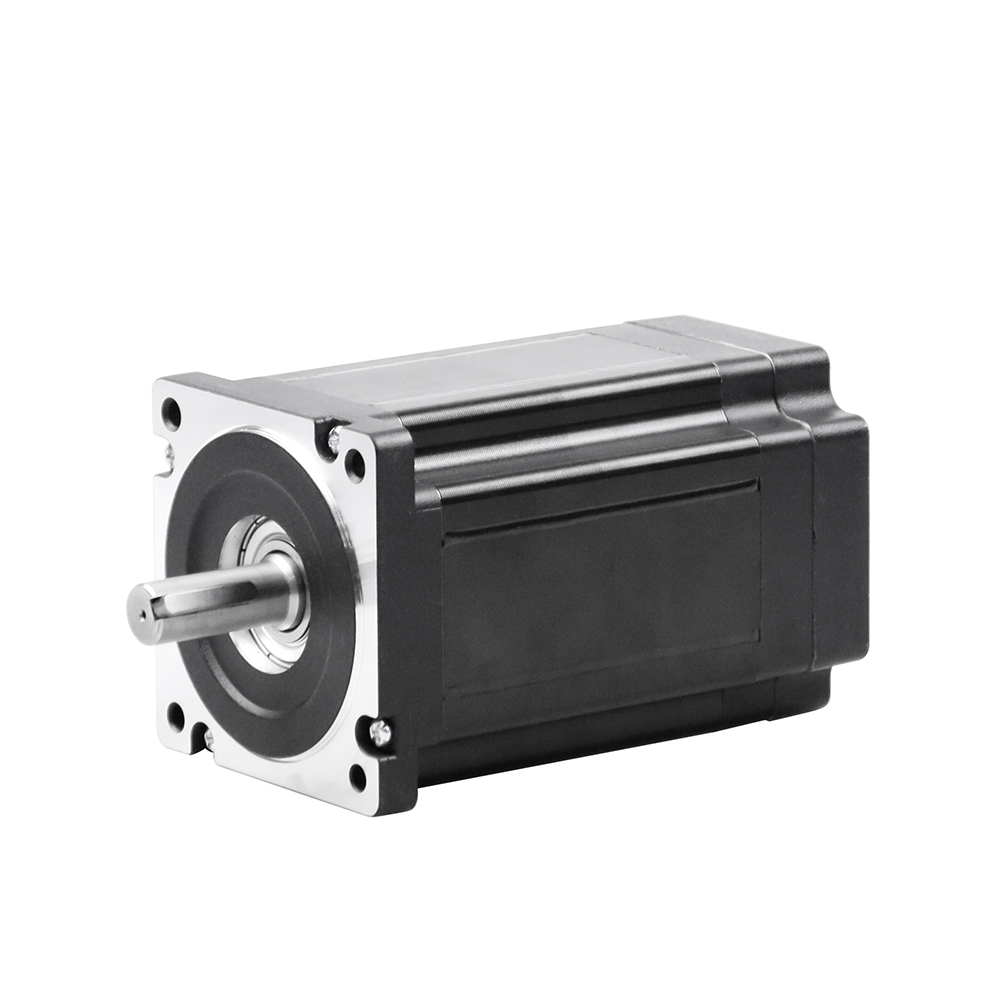
Selecting between a brushed DC motor and a brushless DC motor (BLDC) is a critical engineering and commercial decision that directly impacts efficiency, reliability, lifetime cost, control accuracy, and overall system performance. We present a detailed, objective, and technically grounded comparison designed to help decision-makers identify the optimal motor technology for their specific application.
Fundamental Operating Principles
Brushed DC Motor Working Concept
A brushed DC motor relies on mechanical commutation. Carbon brushes maintain physical contact with a rotating commutator, periodically reversing current direction in the armature windings. This interaction creates a magnetic field that produces rotational torque.
This architecture is simple, intuitive, and has been widely used for decades across consumer and industrial products.
Brushless DC Motor Working Concept
A brushless DC motor eliminates mechanical commutation entirely. Instead, electronic commutation is performed using a motor controller that switches current through the stator windings based on rotor position feedback from Hall sensors or sensorless algorithms.
The rotor typically contains permanent magnets, while the stator carries the windings, resulting in higher efficiency and superior thermal performance.
Efficiency and Energy Consumption Comparison
When evaluating brushed DC motors versus brushless DC motors (BLDC), efficiency and energy consumption represent one of the most decisive technical differences. These factors directly influence operating costs, thermal behavior, system reliability, and long-term sustainability.
Energy Efficiency of Brushed DC Motors
Brushed DC motors inherently suffer from mechanical and electrical losses due to their construction. The continuous physical contact between carbon brushes and the commutator introduces friction, which converts a portion of electrical energy into unwanted heat. Additionally, electrical arcing during commutation causes further power dissipation and electromagnetic losses.
Key efficiency limitations of brushed DC motors include:
Brush friction losses during operation
Commutator resistance losses
Heat buildup in the rotor windings, which are difficult to cool effectively
Reduced efficiency at higher speeds and loads
In practical applications, brushed DC motors typically achieve an efficiency range of 65% to 80%, depending on load conditions, motor size, and duty cycle. As speed increases or continuous operation is required, efficiency declines rapidly due to rising thermal stress.
Energy Efficiency of Brushless DC Motors
Brushless DC motors eliminate mechanical commutation entirely, replacing it with electronic switching controlled by a dedicated drive. This design removes brush-related friction and arcing, resulting in significantly improved energy conversion efficiency.
Key efficiency advantages of brushless DC motors include:
No mechanical contact losses
Optimized electronic commutation timing
Stationary stator windings, allowing superior heat dissipation
Lower copper and iron losses due to precise current control
Modern BLDC motors commonly achieve 85% to 95% efficiency, even under continuous operation. High efficiency remains consistent across a wide speed range, making them ideal for variable-speed and high-duty-cycle applications.
Impact on Power Consumption
Higher efficiency directly translates into lower power consumption for the same mechanical output. In battery-powered systems such as electric vehicles, drones, cordless tools, and medical devices, this efficiency advantage results in:
Longer operating time per charge
Reduced battery size and weight requirements
Lower charging frequency
Improved overall system performance
In grid-powered industrial systems, reduced energy consumption leads to lower electricity costs, especially in 24/7 operations.
Thermal Losses and Their Energy Implications
Energy losses in motors manifest primarily as heat. Excessive heat:
Brushed DC motors concentrate heat within the rotor, where cooling is limited. Brushless motors, by contrast, dissipate heat more effectively through the stator and housing, allowing higher continuous power output without efficiency degradation.
Long-Term Energy Cost Considerations
While brushed DC motors may appear cost-effective initially, their higher energy consumption over time significantly increases total operating expenses. Brushless DC motors, although requiring a higher upfront investment, deliver:
Consistently lower energy usage
Reduced cooling requirements
Stable efficiency over long service life
Over the full lifecycle of the equipment, brushless DC motors provide superior energy economy.
Efficiency Verdict
From an energy and efficiency standpoint, brushless DC motors clearly outperform brushed DC motors. Their ability to convert electrical power into mechanical output with minimal losses makes them the preferred choice for modern applications focused on performance optimization, energy savings, and sustainability.
Torque Characteristics and Speed Control
Torque behavior and speed control capability are fundamental performance indicators when comparing brushed DC motors and brushless DC motors (BLDC). These characteristics determine how accurately a motor can respond to load changes, maintain stable operation, and deliver consistent performance across varying speed ranges.
Torque Characteristics of Brushed DC Motors
Brushed DC motors are well known for their high starting torque. Because torque is directly proportional to armature current, these motors can generate substantial torque at low speeds, including at standstill. This makes them suitable for applications that require immediate motion under load.
Key torque-related characteristics of brushed DC motors include:
High initial torque output, ideal for simple start-stop applications
Linear torque–current relationship, simplifying basic control
Noticeable torque ripple due to mechanical commutation
Declining torque stability at higher speeds
As rotational speed increases, the limitations of brush and commutator contact become more apparent. Mechanical switching introduces uneven current flow, resulting in torque pulsations, vibration, and reduced smoothness, particularly in precision applications.
Speed Control in Brushed DC Motors
Speed control in brushed DC motors is relatively straightforward. By adjusting the applied voltage, motor speed can be regulated with minimal electronics. However, this simplicity comes at the cost of accuracy.
Speed control limitations include:
Speed variation under load changes
Limited precision without feedback systems
Reduced efficiency at partial loads
Inconsistent speed at low RPM
While acceptable for basic systems, brushed DC motors struggle to maintain precise speed control in dynamic or variable-load environments.
Torque Characteristics of Brushless DC Motors
Brushless DC motors provide superior torque consistency across a broad speed range. Electronic commutation ensures optimal current delivery to the stator windings, producing a stable rotating magnetic field that drives the rotor smoothly.
Key torque advantages of BLDC motors include:
High torque density relative to motor size
Smooth and continuous torque output
Minimal torque ripple with proper control algorithms
Excellent torque retention at high speeds
The absence of mechanical commutation allows brushless motors to deliver predictable and repeatable torque even under demanding operating conditions.
Speed Control in Brushless DC Motors
Speed control is one of the strongest advantages of brushless DC motors. Using advanced motor controllers, BLDC motors achieve precise speed regulation through closed-loop control.
Speed control benefits include:
Accurate speed regulation under varying loads
Wide speed range, from near-zero to high RPM
Fast dynamic response to command changes
Stable low-speed operation without stalling
With feedback from Hall sensors or encoders, brushless motors can maintain constant speed and torque with exceptional accuracy, making them ideal for servo and motion-control systems.
Low-Speed and High-Speed Performance Comparison
At low speeds, brushed motors may exhibit jerky motion and uneven torque due to commutation effects. Brushless motors, in contrast, deliver smooth low-speed rotation, even in precision positioning tasks.
At high speeds, brushed motors face increased wear, arcing, and efficiency loss. Brushless motors maintain stable torque output and controlled acceleration, even at elevated RPM levels.
Dynamic Load Handling
Brushless DC motors excel in applications with rapidly changing loads. Electronic control systems adjust current in real time, ensuring:
Brushed motors lack this responsiveness, resulting in speed drop and increased current draw under sudden load changes.
Performance Verdict
From a torque and speed control perspective, brushless DC motors offer superior smoothness, accuracy, and adaptability. Brushed DC motors remain adequate for simple, low-cost applications, but for any system requiring precise torque delivery, stable speed control, and dynamic performance, brushless DC motors are the clear technical choice.
Maintenance Requirements and Operational Lifetime
Brushed Motor Maintenance Profile
Brush wear is unavoidable. Over time, brushes must be:
Inspected
Replaced
Cleaned of carbon dust
This limits the typical lifespan to 1,000–3,000 operating hours, depending on load and environment.
Brushless Motor Maintenance Profile
Brushless motors have:
No wearable commutation components
Minimal mechanical degradation
Extended service intervals
Operational lifetimes often exceed 20,000 hours, making them ideal for continuous-duty and mission-critical applications.
Thermal Management and Reliability
Heat Generation in Brushed Motors
Because the windings are located on the rotor:
Heat dissipation is inefficient
Thermal stress accelerates insulation degradation
Continuous high-load operation is limited
Thermal Advantages of Brushless Motors
In BLDC motors:
Windings are stationary and directly cooled
Heat is easily transferred to the housing
Higher continuous torque is possible
This design dramatically improves thermal stability, reliability, and overload tolerance.
Noise, Vibration, and Electromagnetic Interference
Brushed DC Motor Noise Characteristics
Mechanical contact causes:
This limits suitability in medical, laboratory, and consumer electronics environments.
BLDC motors operate with:
Near-silent performance
Minimal vibration
Reduced EMI emissions
These features are essential in precision instruments, HVAC systems, and high-end consumer devices.
Control Complexity and System Integration
Control Simplicity of Brushed Motors
Brushed motors require only:
This simplicity lowers initial system cost and design time.
Advanced Control of Brushless Motors
Brushless motors require:
Dedicated electronic controllers
Position feedback or sensorless algorithms
PWM and commutation logic
While more complex, this enables:
Closed-loop control
Regenerative braking
Advanced diagnostics
Networked automation
Cost Analysis: Initial vs Total Cost of Ownership
When comparing brushed DC motors and brushless DC motors (BLDC), cost must be evaluated from two distinct perspectives: initial acquisition cost and total cost of ownership (TCO). While upfront pricing often drives early decisions, long-term operational expenses frequently determine the true economic impact of a motor selection.
Initial Cost of Brushed DC Motors
Brushed DC motors typically offer a lower purchase price, making them attractive for cost-sensitive applications and high-volume products. Their simple construction and minimal electronic requirements contribute to reduced initial expenditure.
Key initial cost advantages include:
Lower motor manufacturing cost
No requirement for complex motor controllers
Simple power supply integration
Minimal system design effort
For short-term or disposable applications, this lower entry cost can appear economically favorable.
Initial Cost of Brushless DC Motors
Brushless DC motors generally involve a higher upfront investment. In addition to the motor itself, a dedicated electronic controller is required to manage commutation and speed regulation.
Initial cost factors include:
Higher motor unit cost due to permanent magnets
Additional expense for electronic drive systems
Increased system integration complexity
However, these costs represent an investment in long-term performance, efficiency, and durability rather than a recurring expense.
Maintenance and Replacement Costs
Maintenance is a major differentiator in total cost of ownership.
Brushed DC motors incur ongoing maintenance costs due to:
Brush wear and periodic replacement
Commutator cleaning and servicing
Unplanned downtime caused by brush failure
Higher failure rates in continuous-duty applications
Brushless DC motors, by contrast, require minimal maintenance. With no brushes or commutators, wear is largely limited to bearings, resulting in:
Significantly reduced maintenance labor
Lower spare parts inventory
Greater operational uptime
Over extended service periods, maintenance savings alone often outweigh the higher initial purchase cost of brushless motors.
Energy Consumption and Operating Costs
Energy efficiency plays a critical role in long-term operating expenses. Brushed DC motors consume more power to produce the same output due to friction and electrical losses, increasing electricity or battery costs.
Brushless DC motors deliver:
In continuous-operation or energy-sensitive systems, reduced power usage results in substantial cost savings over time.
Service Life and Replacement Frequency
The typical service life of brushed DC motors is limited by brush degradation, leading to more frequent motor replacement. Repeated replacements increase not only hardware costs but also labor and downtime expenses.
Brushless DC motors offer:
Extended operational lifespan
Lower replacement frequency
Stable performance throughout service life
Longer service intervals translate directly into reduced capital expenditure over the lifecycle of the equipment.
Downtime and Productivity Costs
Unexpected motor failures can be costly in industrial and commercial environments. Brushed motors are more prone to failure due to wear-related issues, increasing the risk of unscheduled downtime.
Brushless motors provide:
In high-value production environments, downtime avoidance alone can justify the higher initial cost of brushless technology.
Total Cost of Ownership Comparison
When evaluated holistically, total cost of ownership includes:
Although brushed DC motors are cheaper initially, their cumulative costs rise rapidly over time. Brushless DC motors, while more expensive upfront, consistently deliver lower total cost of ownership in medium- and long-term applications.
Cost Verdict
From a lifecycle cost perspective, brushless DC motors represent the more economical choice for applications requiring continuous operation, high reliability, and energy efficiency. Brushed DC motors remain suitable where low initial cost and short service life are the primary considerations, but for long-term value and cost efficiency, brushless technology clearly prevails.
Application Suitability Breakdown
Best Applications for Brushed DC Motors
Best Applications for Brushless DC Motors
Electric vehicles and e-bikes
Industrial automation
Robotics and servo drives
Medical devices
Aerospace and defense systems
HVAC compressors and fans
Environmental and Sustainability Considerations
Brushless DC motors support:
Reduced energy consumption
Lower carbon footprint
Longer replacement cycles
Reduced waste from consumable parts
As global efficiency standards tighten, BLDC motors are increasingly favored in sustainable product designs.
Scalability and Future-Proofing
Brushless technology aligns with:
Brushed motors, while still relevant in niche applications, lack scalability for future intelligent systems.
Final Technical Verdict
From an engineering, economic, and performance standpoint, brushless DC motors outperform brushed DC motors in nearly every measurable category—efficiency, reliability, lifespan, control precision, and sustainability.
Brushed DC motors remain viable where simplicity and low initial cost are the primary constraints. However, for any application demanding high performance, long service life, and advanced control, brushless DC motors are unequivocally the superior choice.