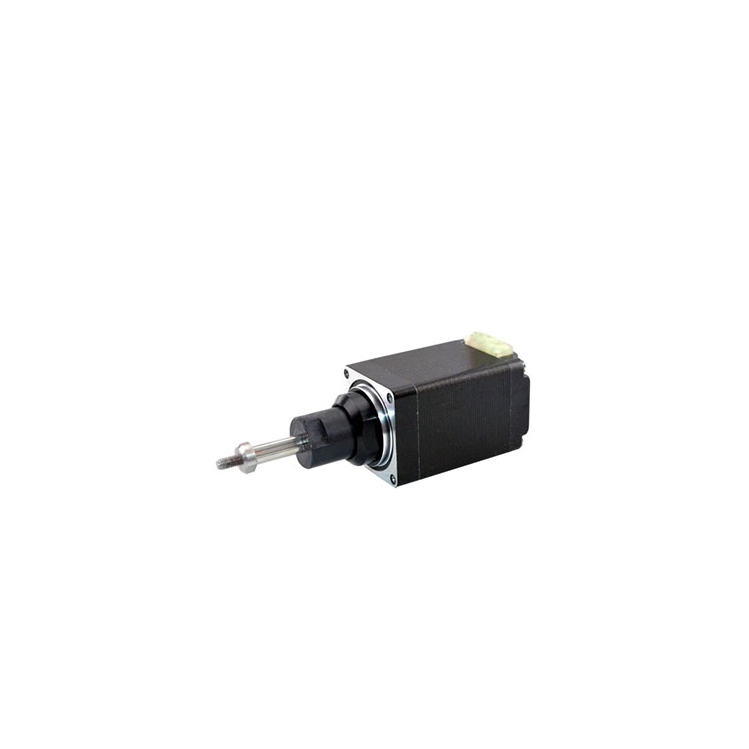
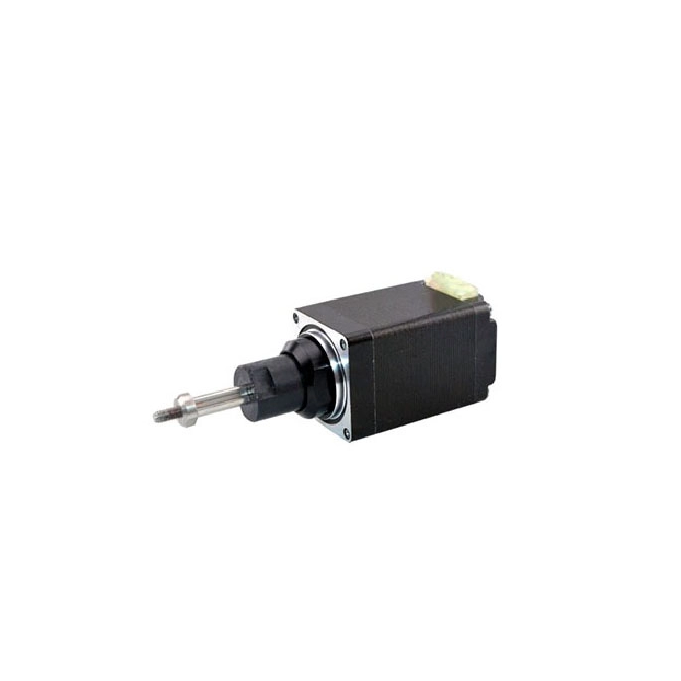
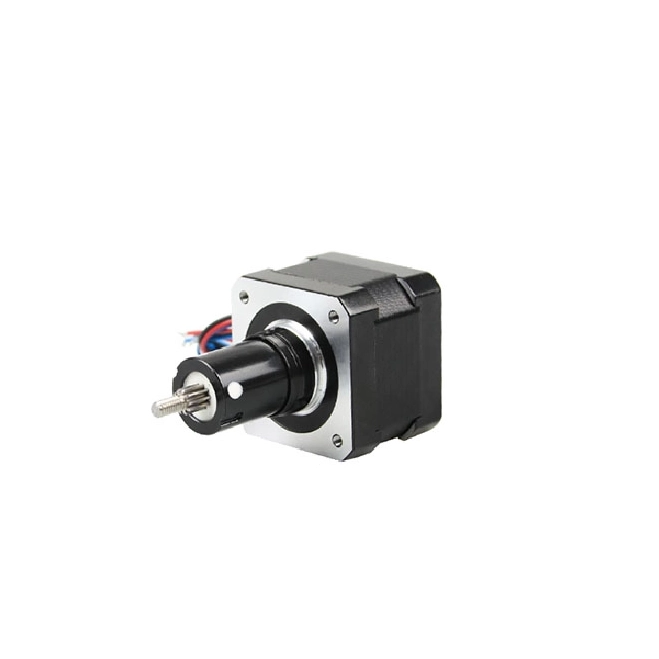
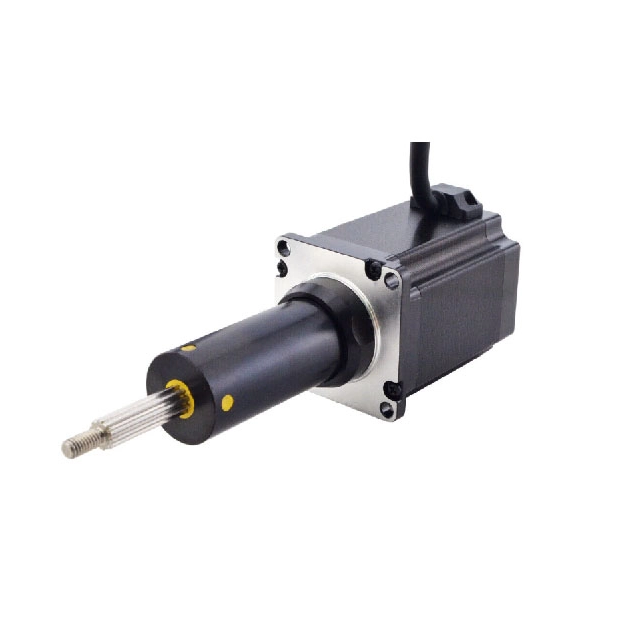
A captive linear stepper motor is a specialized electromechanical device that converts the traditional rotary motion of a stepper motor into precise, controlled linear movement. Unlike conventional stepper motors that rotate endlessly, a captive linear stepper motor integrates an internal lead screw and anti-rotation mechanism to deliver linear motion without requiring external guidance. This self-contained design makes it an indispensable choice for compact automation systems that demand accuracy, repeatability, and mechanical simplicity.
Below is an in-depth, high-authority explanation suitable for engineers, designers, and technical decision-makers evaluating linear motion systems.
Understanding the Working Principle of Captive Linear Stepper Motors
A captive linear stepper motor operates using the same electromagnetic stepping principle found in standard hybrid stepper motors, but with one crucial difference—the motor's rotor is modified to drive a precision lead screw instead of generating continuous rotation.
Key internal elements include:
Hybrid stepper motor stator and rotor assembly
Built-in precision lead screw
Captive, non-rotating plunger (or shaft)
Anti-rotation guide mechanism
Integrated thrust bearings
When electrical pulses energize the stator windings, the rotor magnetizes and advances step-by-step. Since the rotor is attached to the lead screw, each step translates into incremental linear motion of the plunger. The anti-rotation mechanism ensures the shaft moves only linearly, never twisting.
This ability to generate predictably incremental linear displacement per motor step is what gives captive linear stepper motors their unique precision advantage.
Key Features That Make Captive Linear Stepper Motors Highly Efficient
Captive linear stepper motors are engineered for performance-critical motion systems. Their defining features include:
1. Self-Guided Plunger System
The internal anti-rotation guide ensures the shaft moves smoothly without wobble. This eliminates the need for external alignment components.
2. High Accuracy and Repeatability
Because each motor step corresponds to a fixed linear displacement, users can achieve micrometer-level positioning accuracy.
3. Direct Linear Motion Without External Hardware
No couplings, gears, or additional transmission elements are required. This simplifies assembly, reduces weight, and minimizes mechanical wear.
4. High Holding Force at Standstill
Stepper motors inherently provide excellent holding torque. In captive versions, this translates into stable, vibration-free linear force retention.
5. Compact and Space-Efficient Construction
The built-in lead screw and guide system allow for short overall lengths, ideal for space-constrained applications.
Advantages of Captive Linear Stepper Motors in Modern Automation Systems
Opting for a captive linear stepper motor brings numerous engineering and logistical advantages:
■ Eliminates the Need for External Anti-Rotation Devices
Traditional linear stepper motor designs often require the user to develop custom anti-rotation fixtures. Captive designs solve this internally.
■ Predictable Linear Step Resolution
The linear travel per step is determined by the motor's step angle (typically 1.8°) and the lead screw pitch. This ensures fully deterministic motion control.
■ Low Maintenance
No external couplings or guide rails means fewer mechanical failure points, lowering long-term maintenance costs.
■ Clean, Fast, and Efficient Integration
Captured lead screw systems reduce system friction and simplify installation, making them ideal for medical and laboratory devices.
■ Robust Performance Under Load
The integrated thrust bearings enable the motor to sustain axial loads without sacrificing precision.
Where Captive Linear Stepper Motors Are Used
These motors are widely applied across various industries requiring miniaturized, repeatable motion.
1. Medical and Life Sciences Equipment
Their clean linear motion and mechanical reliability are essential in sterile or sensitive environments.
2. Robotics and Automation
Robotics requires compact actuators with precise feedback-free positioning—an ideal match for captive motors.
3. Semiconductor and Electronics Manufacturing
High repeatability is crucial for micrometer-scale manufacturing processes.
4. Aerospace and Defense
The lightweight, compact form factor enables integration into tight spaces.
5. Consumer and Industrial Equipment
Automated locks
Linear indexing systems
Small-scale actuators
Because they do not require external motion transmission mechanisms, they are perfect for compact consumer devices.
Captive vs. Non-Captive Linear Stepper Motors: What's the Difference?
Linear stepper motors come in two primary configurations: captive and non-captive. Although both convert the rotary motion of a stepper motor into linear motion using an internal lead-screw mechanism, they differ significantly in structure, guidance requirements, and ideal applications. Understanding these differences is essential when selecting the correct actuator for a motion system.
1. Captive Linear Stepper Motors
A captive linear stepper motor is a fully integrated, self-guided actuator. It includes:
How It Works
As the rotor turns the lead screw, the anti-rotation guide keeps the plunger from spinning, so it moves strictly in a linear direction. No additional mechanical parts or external guidance systems are required.
Advantages
Plug-and-play linear motion
No external anti-rotation components needed
Compact and mechanically simple design
Strong axial stability
Ideal for precise short-stroke motion
Limitations
Limited stroke length (usually short to medium)
Not ideal for long-travel applications
Slightly higher cost due to integrated components
Common Applications
2. Non-Captive Linear Stepper Motors
A non-captive linear stepper motor has a rotating lead screw that passes completely through the motor body. The screw rotates with the motor—but the nut that converts rotation into linear motion is external and supplied by the user.
How It Works
The lead screw rotates when the motor is energized. A separate external nut mounted on the screw travels linearly as the screw turns. The system designer must implement an anti-rotation guide for the nut or the moving assembly.
Advantages
Unlimited travel length (defined by screw length)
Highly flexible mechanical integration
Ideal for long-stroke applications
Easy to pair with various external guides or carriages
Limitations
Requires user-supplied anti-rotation and guidance
More complex to integrate
Results depend on quality of external components
Common Applications
3. Key Differences at a Glance
| Feature | Captive Linear Stepper Motor | Non-Captive Linear Stepper Motor |
| Lead Screw Behavior | Internal screw, does not protrude | Screw passes through motor body |
| Shaft Motion | Linear only, no rotation | Screw rotates; external nut moves |
| Anti-Rotation | Built into motor | Must be provided externally |
| Stroke Length | Limited, fixed | Can be very long |
| Ease of Integration | Very high | Moderate to complex |
| Typical Use | Compact, precise short motion | Long-travel or custom mechanical systems |
4. Which Should You Choose?
Choose captive if you need:
Simple integration with no external mechanics
Accurate short-range linear motion
A compact, self-contained actuator
Medical, lab, or compact automation functionality
Choose non-captive if you need:
Long distance linear travel
Custom mechanical design freedom
Integration with existing guide rails or carriages
Higher flexibility in system layout
How to Select the Right Captive Linear Stepper Motor
Choosing the correct motor requires evaluating several engineering criteria:
1. Required Linear Travel (Stroke Length)
Captive stepper motors typically offer short-to-medium stroke lengths, often between 5 mm and 50 mm.
2. Linear Force Requirements
Determine:
3. Speed vs. Resolution Trade-Off
Higher screw pitch increases speed but reduces resolution. Fine-pitch screws increase precision.
4. Environmental Conditions
Evaluate:
Temperature range
Humidity
Cleanliness requirements
Duty cycle
5. Power and Driver Compatibility
Ensure the motor's current rating matches your driver's capabilities.
6. Mounting Constraints
Captive designs reduce custom mechanical requirements but still must fit within your device's envelope.
Why Captive Linear Stepper Motors Are Crucial for Precision Engineering
A captive linear stepper motor provides an ideal balance of accuracy, simplicity, and compact mechanical architecture. Its integrated design eliminates the common pitfalls of external guidance systems, enabling engineers to build smaller, more reliable devices with predictable performance.
With rising demand for miniaturized, high-precision automation, captive stepper motors continue to be the preferred choice for industries seeking motion control solutions that are stable, cost-effective, and technically robust.