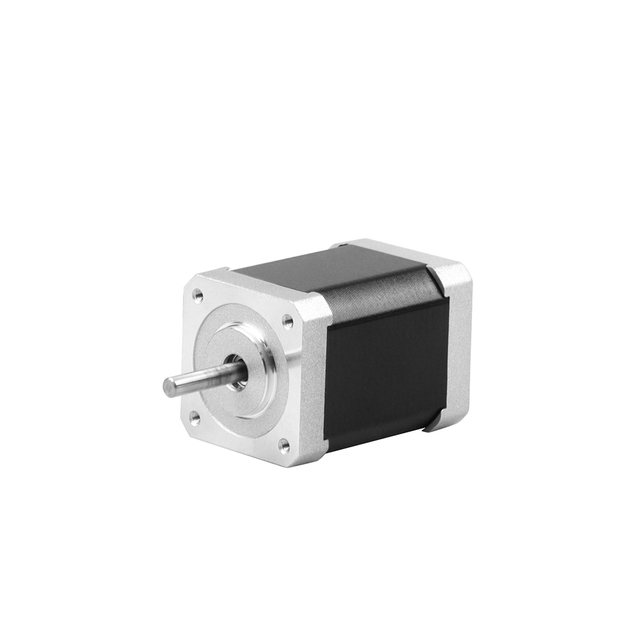
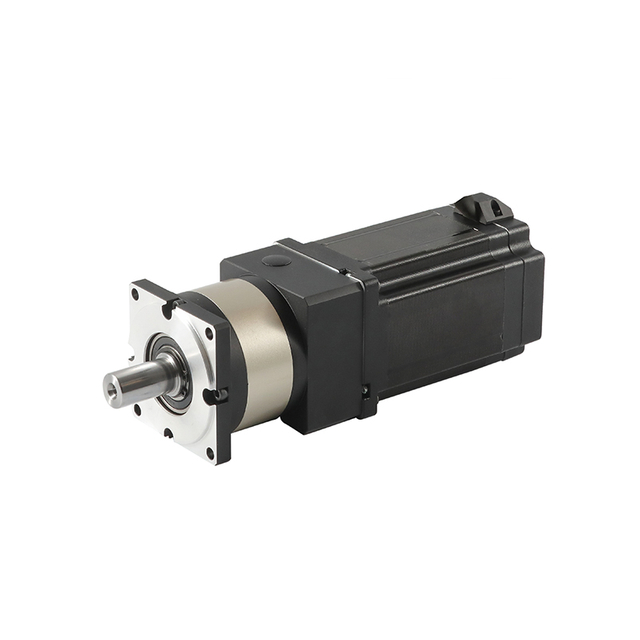
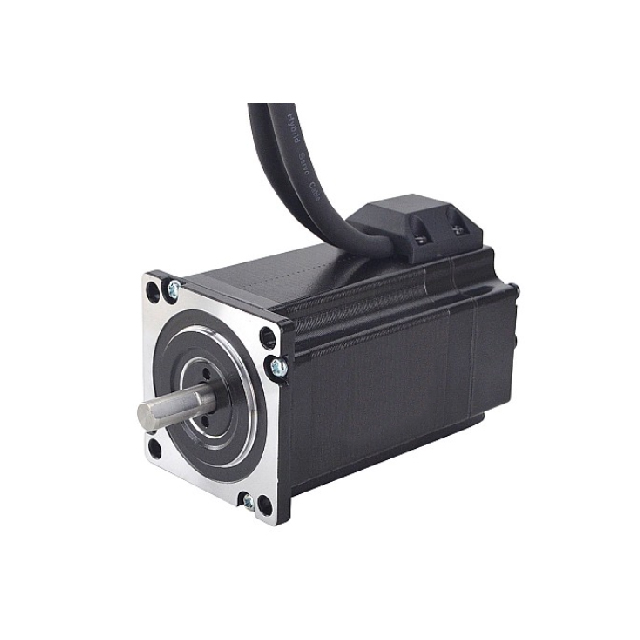
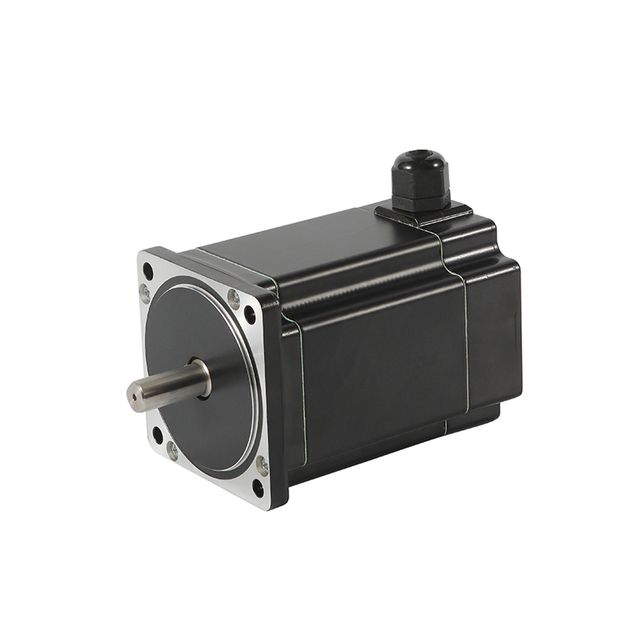
A 3-phase stepper motor is a highly precise and efficient electromechanical device designed to convert electrical pulses into mechanical movement. Unlike conventional 2-phase stepper motors, which are more commonly used, the 3-phase variant offers smoother operation, higher torque output, and greater stability, making it ideal for demanding industrial automation, robotics, and CNC applications. In this article, we will explore the working principles, structure, advantages, and applications of 3-phase stepper motors in depth.
Understanding the Fundamentals of Stepper Motors
A stepper motor operates by dividing a full rotation into a large number of discrete steps. Each electrical pulse sent to the motor’s driver corresponds to one step of the motor shaft. This digital motion control capability allows stepper motors to achieve precise angular positioning without the need for feedback systems.
Stepper motors are categorized by their phase configuration—the number of coil windings that are energized in sequence. The most common types are:
The 3-phase design offers several performance benefits due to its balanced torque characteristics and smoother rotation.
Key Features of Stepper Motors
Precise Positioning: Each pulse corresponds to a specific movement angle (e.g., 1.8° or 0.9° per step).
Open-Loop Control: No need for feedback sensors in many applications.
High Holding Torque: Maintains position when powered.
Reliable Repeatability: Ideal for applications requiring consistent motion patterns.
Simple Control System: Driven easily by stepper drivers or microcontrollers.
Understanding Gear Motors
A gear motor is essentially an electric motor integrated with a gearbox. The purpose of the gearbox is to reduce speed and increase torque. Gear motors can use various types of motors—AC, DC, or brushless DC (BLDC)—as their driving component, with the gearbox tailored to meet specific speed and torque requirements.
How Gear Motors Work
A gear motor combines the rotational motion of the motor with a gear reduction mechanism. When the motor's shaft turns, the gears inside the gearbox modify the output speed and torque according to the gear ratio. For example, a 10:1 gear ratio means the output shaft turns one revolution for every ten revolutions of the motor shaft, effectively multiplying torque by ten while reducing speed by the same factor.
Key Features of Gear Motors
High Torque Output: The gearbox increases torque, making it suitable for heavy-load applications.
Reduced Speed: Controlled output speed ideal for precise movement.
Compact Design: Integrated system reduces the need for external transmission components.
Versatile Motor Options: Compatible with AC, DC, and brushless types.
Durability: Gear systems often made from hardened steel or reinforced plastic for longevity.
Construction of a 3-Phase Stepper Motor
A 3-phase stepper motor is a precision-controlled electromechanical device designed to convert electrical pulses into accurate angular movement. Its construction is more sophisticated than that of a 2-phase motor, providing smoother operation, higher torque, and improved stability. The motor’s structure can be divided into two main parts: the stator and the rotor, each playing a crucial role in generating controlled motion.
1. Stator Structure
The stator is the stationary outer portion of the motor and contains three sets of windings, corresponding to the three electrical phases — A, B, and C. These windings are positioned 120° apart around the stator core.
Each winding is made of enameled copper wire and is placed within laminated steel slots to minimize eddy current losses and improve magnetic efficiency. The windings can be connected in either of the following configurations:
Star (Y) Connection: The ends of all three windings are connected at a common point, and the other ends are brought out as phase terminals. This configuration is often preferred for balanced torque and efficiency.
Delta (Δ) Connection: Each winding is connected end-to-end to form a closed loop. This arrangement allows for higher torque output and is often used in applications requiring more power.
When current flows through these windings in a controlled sequence, a rotating magnetic field is generated, which drives the rotor to move step-by-step.
2. Rotor Structure
The rotor is the rotating part of the motor and is typically composed of ferromagnetic material or permanent magnets. Its design directly affects the precision, torque, and step resolution of the motor.
There are two common rotor types used in 3-phase stepper motors:
a. Variable Reluctance (VR) Rotor
This rotor type has soft iron teeth but no permanent magnets. The rotor teeth align with the stator’s magnetic poles when a phase is energized, creating motion by the principle of minimum reluctance. It provides high step resolution but moderate torque.
b. Hybrid Rotor
The hybrid rotor combines permanent magnets and toothed construction. It uses an axially magnetized permanent magnet sandwiched between two toothed iron cups, with teeth slightly offset. This design offers high torque, fine step angles (as small as 1.2° or 0.9°), and superior precision, making it ideal for industrial and robotics applications.
3. Shaft and Bearings
The rotor shaft, typically made of hardened steel, transmits mechanical power from the motor to the load. It is supported by precision ball bearings on both ends to ensure smooth, frictionless rotation and long service life.
High-quality bearings reduce mechanical noise and vibration, enhancing the motor’s overall reliability and performance.
4. Housing and Enclosure
The entire assembly is enclosed in a metal housing—usually aluminum or steel—for protection and heat dissipation. The housing also ensures mechanical stability and shields the internal components from dust, moisture, and external vibrations.
Some high-performance 3-phase stepper motors are equipped with cooling fins or ventilation slots to improve thermal efficiency during continuous operation.
5. Magnetic Field Interaction
When the 3-phase windings are energized sequentially, each phase produces a rotating magnetic field that interacts with the rotor’s magnetic poles. This interaction causes the rotor to align, move, and step precisely according to the applied pulse sequence. The continuous switching of current among the three windings results in smooth rotational motion with minimal torque ripple.
6. Electrical Connections and Driver Interface
The 3-phase stepper motor is connected to a dedicated driver circuit that controls the current flow through each phase. The driver receives step and direction signals from a controller or microprocessor and converts them into phase excitation patterns.
Advanced drivers often use microstepping technology, which divides each full step into smaller increments by adjusting the current in each phase proportionally. This technique results in ultra-smooth motion, reduced vibration, and enhanced positioning accuracy.
7. Summary of Construction Features
| Component | Function | Key Features |
| Stator | Generates rotating magnetic field | 3-phase windings, 120° apart |
| Rotor | Converts magnetic force into rotation | Permanent magnet or toothed iron design |
| Shaft | Transfers motion to load | Precision steel with bearings |
| Bearings | Support smooth rotation | High-precision, low-friction |
| Housing | Provides protection & cooling | Metal casing with optional fins |
| Driver Interface | Controls phase excitation | Enables microstepping and torque control |
Conclusion
The construction of a 3-phase stepper motor reflects a perfect blend of mechanical precision and electromagnetic engineering. Its three-phase stator winding system, high-performance rotor design, and robust mechanical components enable smoother, quieter, and more accurate motion compared to traditional 2-phase designs.
Thanks to this advanced structure, 3-phase stepper motors are widely used in CNC machinery, robotics, 3D printers, medical devices, and industrial automation systems, where precision, torque, and reliability are critical.
Working Principle of a 3-Phase Stepper Motor
The operation of a 3-phase stepper motor relies on sequential energization of its three stator phases — A, B, and C. When phase A is energized, the rotor aligns with the magnetic field produced by that phase. As the excitation shifts to phase B and then to phase C, the rotor moves incrementally, producing a step-by-step rotational motion.
The sequence of energization is typically:
Phase A → Phase B → Phase C
Phase C → Phase B → Phase A (for reverse rotation)
Each shift corresponds to a specific step angle, calculated using the formula:
Step Angle (°) = 360° / (Number of Rotor Teeth × Number of Phases)
For example, a 3-phase stepper motor with 50 rotor teeth would have:
Step Angle = 360° / (50 × 3) = 2.4° per step
This fine resolution allows for high-precision control in positioning systems.
Drive Modes in 3-Phase Stepper Motors
A 3-phase stepper motor operates by sequentially energizing its three stator windings to create a rotating magnetic field that drives the rotor in precise steps. The way these windings are energized determines the motor's motion smoothness, torque output, and accuracy. These excitation patterns are known as drive modes.
Selecting the proper drive mode is crucial to optimizing performance for a given application—whether it demands high torque, fine resolution, or smooth rotation. Below, we explore the main drive modes used in 3-phase stepper motor and how each affects their operation.
1. Full-Step Drive
The full-step drive is the simplest and most traditional mode of operation. In this method, each phase winding of the 3-phase stepper motor is energized in a specific sequence to produce one full step per input pulse.
Working Principle
In a full-step mode, one or two phases are energized at a time, creating a strong and stable magnetic field that pulls the rotor into alignment. The standard excitation sequence for a 3-phase motor is as follows:
A → B → C → A → B → C
As each phase is energized in turn, the rotor advances by a fixed angle—known as the step angle. For a 3-phase stepper motor, this is typically 1.2° to 2.4° per step, depending on the motor’s construction.
Advantages
High torque output due to maximum magnetic field strength.
Simple control circuitry and easy implementation.
Reliable and consistent step movement.
Disadvantages
This drive mode is suitable for applications where torque is prioritized over smoothness, such as mechanical actuators or valve controls.
2. Half-Step Drive
The half-step drive mode combines the advantages of single- and dual-phase excitation to provide smoother motion and improved resolution. It effectively doubles the number of steps per revolution, reducing vibration and enhancing positional accuracy.
Working Principle
In half-step driving, the motor alternates between one-phase-on and two-phase-on states. The excitation sequence becomes:
A → A+B → B → B+C → C → C+A → A
This doubles the stepping frequency without increasing motor speed, resulting in half the step angle compared to full-step driving. For example, if the full-step angle is 1.2°, the half-step angle becomes 0.6° per step.
Advantages
Higher resolution and smoother motion.
Reduced vibration and mechanical resonance.
Balanced compromise between torque and smoothness.
Disadvantages
Half-step driving is commonly used in CNC machinery, robotic joints, and positioning systems, where smooth motion is important but torque requirements remain moderate.
3. Microstepping Drive
Microstepping is the most advanced and precise drive method for 3-phase stepper motors. Instead of energizing phases in simple on/off states, current levels are finely controlled through each winding in a sinusoidal or trapezoidal waveform. This allows the motor to move in tiny fractional steps, achieving ultra-smooth motion.
Working Principle
In microstepping, each full step is divided into multiple smaller steps (for example, 8, 16, 32, or even 256 microsteps per full step). The currents through the three phases are controlled according to a mathematical relationship, typically:
IA = I × sin(θ)
IB = I × sin(θ + 120°)
IC = I × sin(θ + 240°)
This creates a rotating magnetic field that smoothly transitions from one step to the next. The rotor follows this field continuously, minimizing vibration and noise.
Advantages
Exceptionally smooth and quiet operation.
Ultra-high positioning accuracy and resolution.
Greatly reduced resonance and mechanical wear.
Better low-speed performance.
Disadvantages
Reduced torque per microstep (as the current is divided among phases).
More complex and expensive driver electronics.
Higher computational demand from the controller.
Microstepping is ideal for high-precision applications such as 3D printers, semiconductor equipment, medical devices, and optical systems, where motion smoothness and accuracy are critical.
4. Wave Drive (Single-Phase Excitation)
Although less common, the wave drive (or single-coil excitation) method can also be applied to 3-phase stepper motors. In this mode, only one phase is energized at a time, producing one step per pulse.
Advantages
Disadvantages
This mode is suitable for light-duty applications or when energy efficiency is a higher priority than torque.
5. Comparison of Drive Modes
| Drive Mode | Phases Energized | Step Angle | Torque | Smoothness | Applications |
| Wave Drive | 1 | Full step | Low | Moderate | Low-power systems |
| Full-Step | 1 or 2 | Full step | High | Average | Actuators, general machinery |
| Half-Step | Alternating 1 & 2 | Half step | Medium | Good | Robotics, CNC drives |
| Microstepping | 3 (variable current) | Fractional step | Moderate | Excellent | Precision instruments, 3D printers |
Conclusion
The drive mode of a 3-phase stepper motor determines how efficiently and accurately it performs in an application.
Full-step mode delivers maximum torque and simplicity.
Half-step mode offers a balance between torque and smoothness.
Microstepping mode provides the highest precision and quietest motion.
By carefully selecting the right drive mode and pairing it with a high-quality motor driver, engineers can achieve optimal motion control for their specific needs, from industrial automation to high-end robotics.
Advantages of 3-Phase Stepper Motors
The 3-phase configuration provides numerous advantages over traditional 2-phase models:
1. Higher Torque Output
With three active phases, the motor can produce more torque per unit volume, making it ideal for high-load or high-speed applications.
2. Smoother Operation
Due to the 120° phase difference, the torque ripple is significantly reduced, resulting in silky-smooth rotation and lower vibration.
3. Improved Efficiency
Current distribution across three windings allows better thermal management and energy efficiency, enhancing overall system reliability.
4. Reduced Resonance and Noise
The multi-phase excitation pattern minimizes mechanical resonance, providing quiet and stable motion, especially beneficial in medical equipment and optical devices.
5. Better Acceleration and Deceleration
The enhanced electromagnetic balance allows faster acceleration and deceleration rates, which improves response time in dynamic systems.
Applications of 3-Phase Stepper Motors
The precision, reliability, and performance of 3-phase stepper motors make them indispensable in many advanced motion control systems. Common applications include:
CNC Machines: For precise tool positioning and cutting.
Robotics: Providing accurate joint movement and arm positioning.
3D Printers: Ensuring high-resolution layer formation.
Medical Devices: Used in imaging systems and surgical robots for smooth, controlled motion.
Semiconductor Equipment: Essential for wafer positioning and inspection tools.
Textile and Packaging Machinery: Enabling high-speed material handling and control.
Aerospace and Defense: In applications requiring high accuracy and reliability under demanding conditions.
3-Phase vs 2-Phase Stepper Motors: Key Differences
| Feature | 2-Phase Stepper Motor | 3-Phase Stepper Motor |
| Number of Windings | Two | Three |
| Step Angle | 1.8° typical | 1.2° or smaller |
| Torque Ripple | Higher | Lower |
| Vibration Level | Moderate | Very Low |
| Torque Output | Moderate | Higher |
| Smoothness of Motion | Average | Excellent |
| Efficiency | Good | Superior |
| Cost | Lower | Slightly Higher |
In short, while 2-phase stepper motors are more economical and sufficient for general-purpose applications, 3-phase stepper motors excel where precision, smoothness, and performance are top priorities.
Selecting the Right 3-Phase Stepper Motor
When choosing a 3-phase stepper motor for your system, consider the following factors:
Torque and Speed Requirements – Match the torque-speed curve to your load characteristics.
Step Angle and Resolution – Select based on positional accuracy needs.
Voltage and Current Ratings – Ensure compatibility with your driver.
Mounting and Size Constraints – Choose the appropriate NEMA frame size.
Environment – Consider ambient temperature, humidity, and vibration conditions.
Pairing the motor with a high-quality microstepping driver will further enhance performance and control precision.
Conclusion
A 3-phase stepper motor represents the perfect balance of torque, precision, and smoothness, making it a superior choice for advanced motion control systems. Its refined electromagnetic structure and efficient torque production enable smoother and quieter performance than standard 2-phase designs. From industrial automation to medical technology, these motors deliver unmatched reliability and accuracy, driving innovation across countless sectors.
If you’re designing a system that demands exceptional motion accuracy, investing in a 3-phase stepper motor can elevate both performance and productivity.