Introduction to NEMA Stepper Motor Standards
When comparing NEMA 17, NEMA 23, and NEMA 34 stepper motors, we focus on performance-critical factors such as torque output, physical size, power requirements, and real-world application suitability. The NEMA standard defines the motor's mounting faceplate dimensions, not its electrical or torque performance. However, in practical engineering and industrial usage, NEMA size strongly correlates with torque capacity, current handling, and mechanical strength.
As stepper motor manufacturers and system integrators, we evaluate these three NEMA frame sizes from a performance-driven and application-oriented perspective, helping engineers, OEMs, and automation designers select the optimal motor for their motion control systems.
Understanding Stepper Motor Torque and Frame Size Relationship
Stepper motor torque scales with:
Larger NEMA sizes typically deliver higher holding torque, better resistance to load variation, and improved stability at low speeds. However, they also require more space, higher power, and stronger mechanical structures.
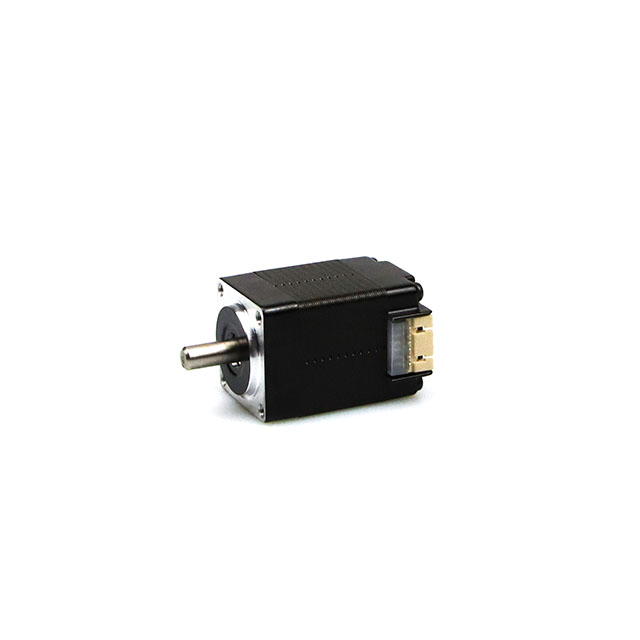
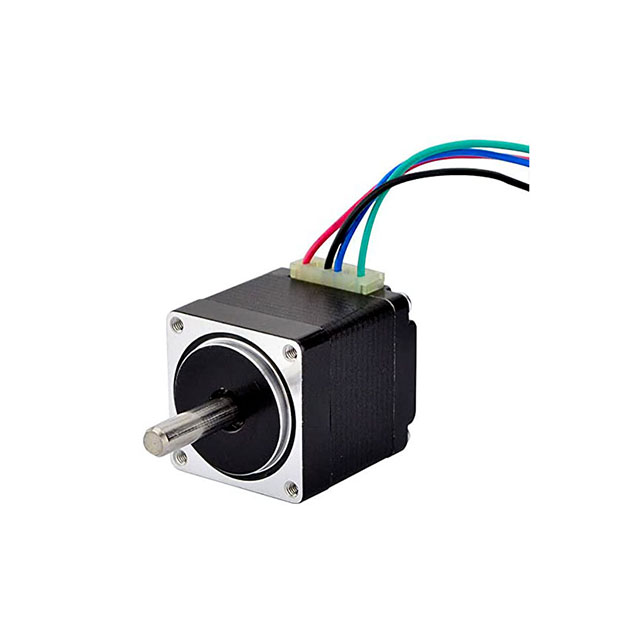
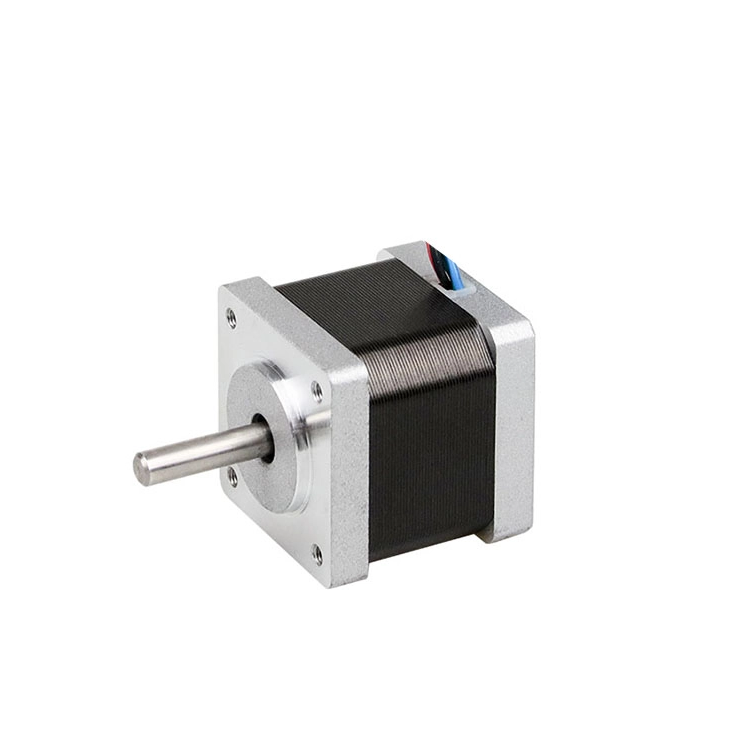
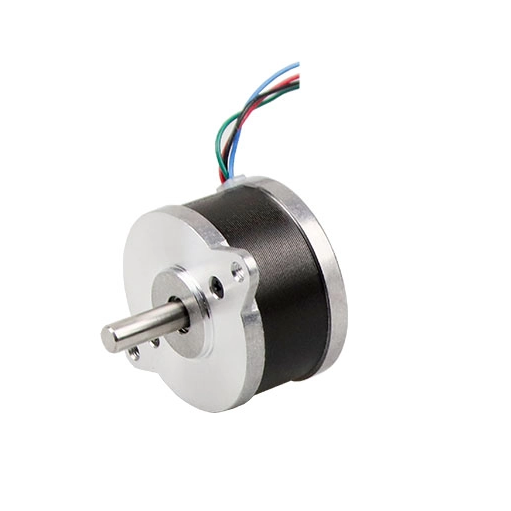
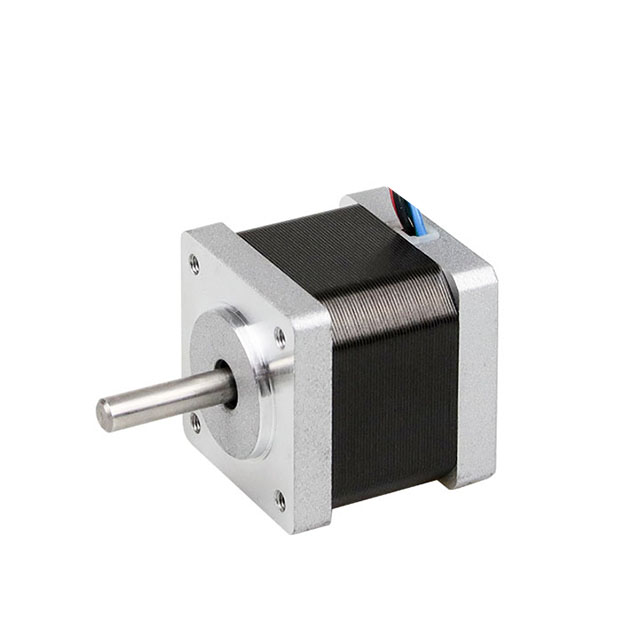
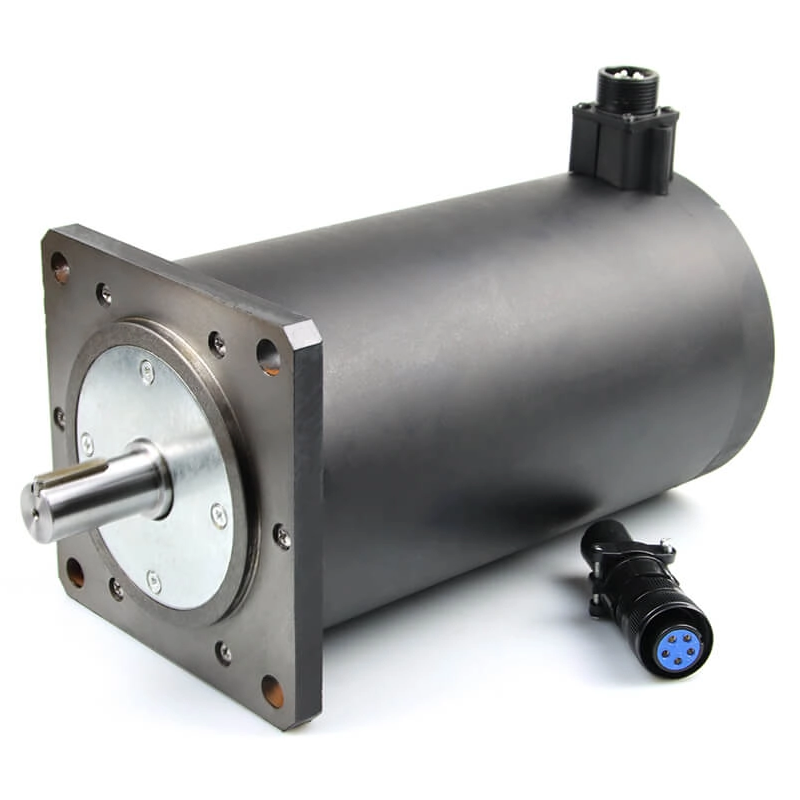
LeanMotor Standard Stepper Motor
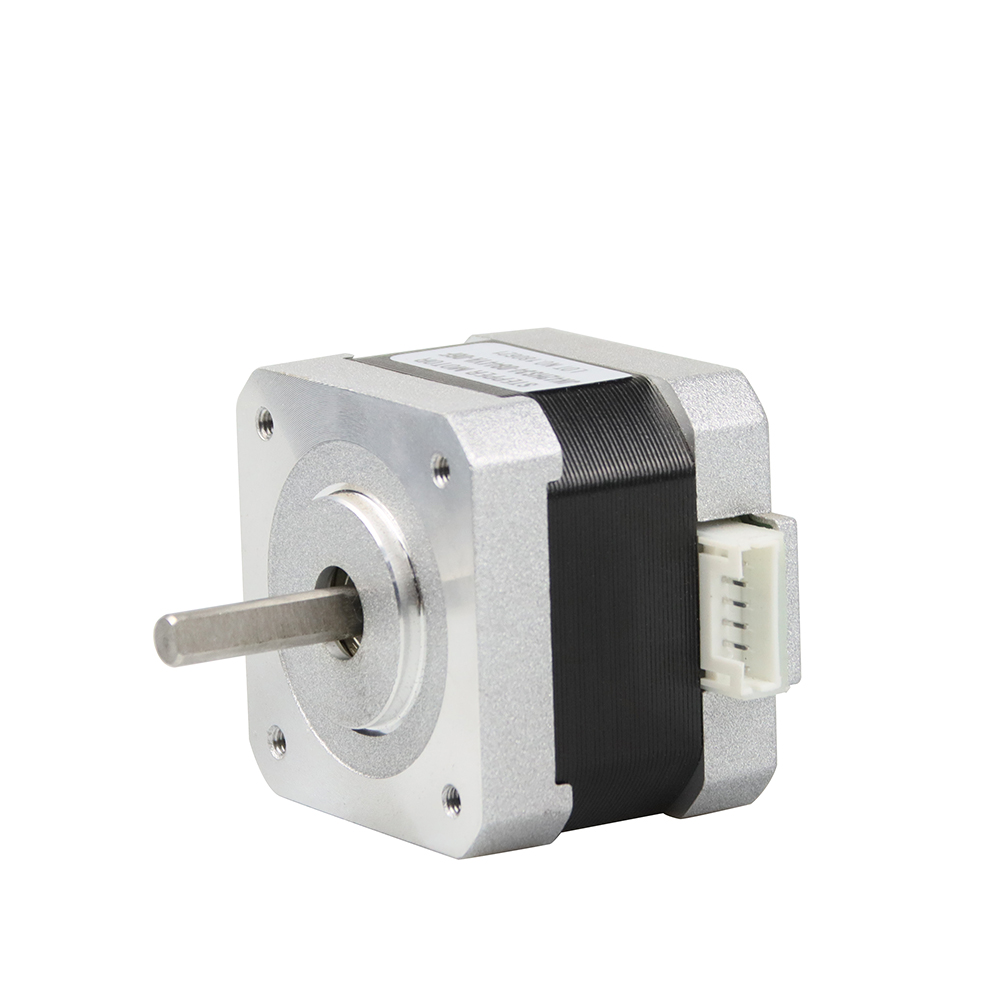
NEMA 17 Stepper Motors: Compact Precision for Light Loads
NEMA 17 Technical Overview
Faceplate size: 42 × 42 mm
Typical holding torque: 30–80 N·cm
Rated current: 0.8–2.0 A
Voltage range: 2–6 V (coil rated)
Shaft diameter: 5 mm
Performance Characteristics
NEMA 17 stepper motors excel in precision positioning, low inertia systems, and compact mechanical designs. Their smaller rotor mass enables faster acceleration and deceleration, making them ideal for applications where speed response and positioning accuracy matter more than brute force.
With microstepping drivers, NEMA 17 motors deliver smooth motion control and reduced resonance, even in open-loop systems.
Typical Applications
Advantages
Limitations
Limited torque for heavy loads
Reduced performance at higher speeds
Not suitable for industrial-duty cycles
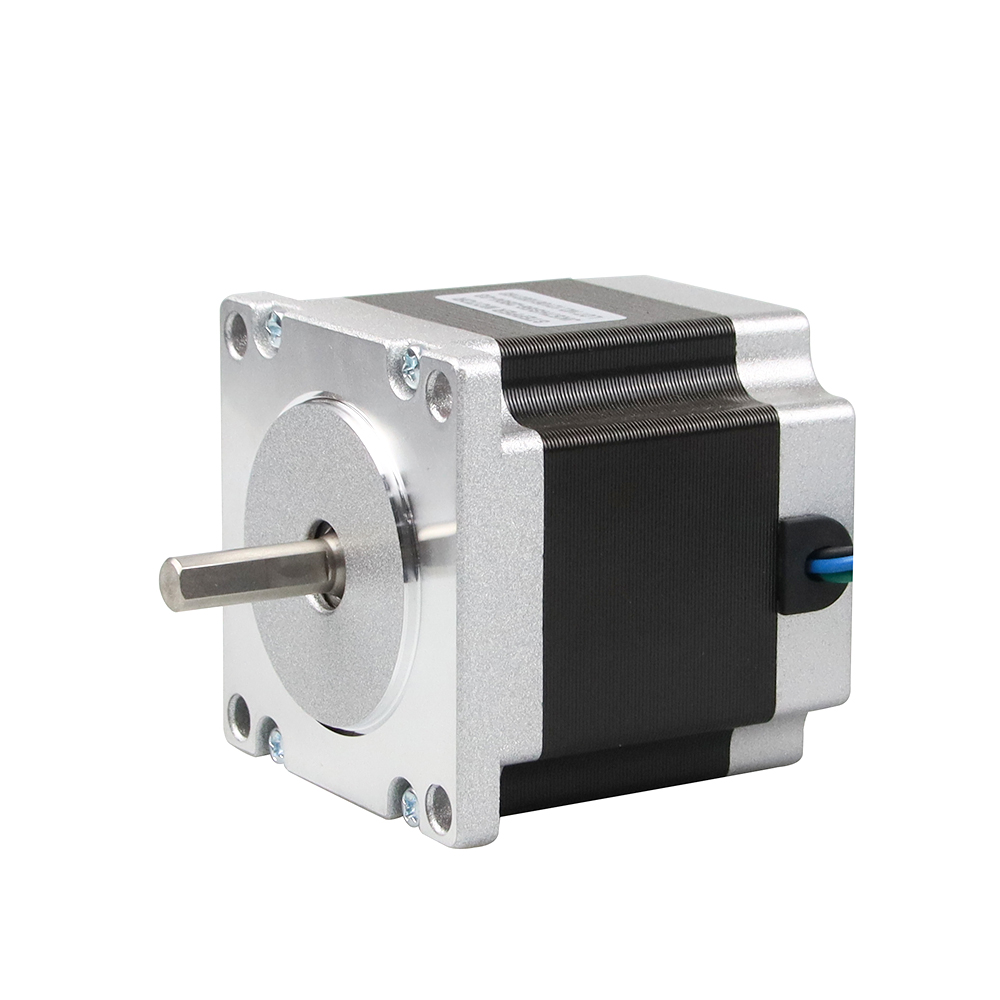
NEMA 23 Stepper Motors: Balanced Power and Versatility
NEMA 23 Technical Overview
Faceplate size: 57 × 57 mm
Typical holding torque: 120–300 N·cm
Rated current: 2.0–4.5 A
Voltage range: 3–8 V (coil rated)
Shaft diameter: 6.35–8 mm
Performance Characteristics
NEMA 23 stepper motors represent the most widely used industrial stepper motor size. They provide a strong balance between torque, speed, and size, making them suitable for both desktop and light industrial automation.
Compared to NEMA 17, NEMA 23 motors maintain higher torque at mid-range speeds, especially when paired with high-voltage stepper drivers.
Typical Applications
Advantages
Strong torque-to-size ratio
Broad availability of drivers and accessories
Suitable for continuous-duty operation
Easy integration with gearboxes and brakes
Limitations
Higher power consumption than NEMA 17
Requires robust power supply and cooling
Larger footprint in compact systems
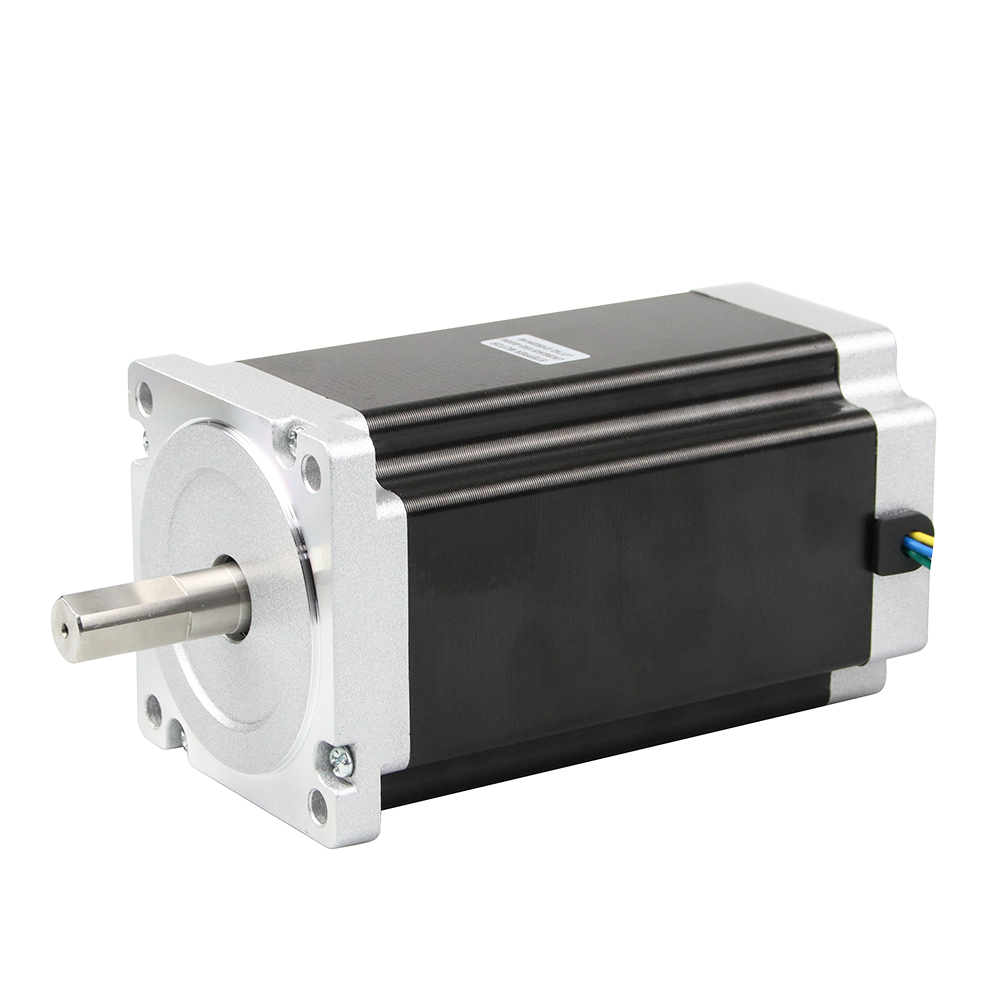
NEMA 34 Stepper Motors: Industrial Torque for Heavy-Duty Motion
NEMA 34 Technical Overview
Faceplate size: 86 × 86 mm
Typical holding torque: 400–1200 N·cm
Rated current: 4.0–8.0 A
Voltage range: 4–12 V (coil rated)
Shaft diameter: 12–14 mm
Performance Characteristics
NEMA 34 stepper motors are designed for high-load, high-inertia, and industrial-grade applications. Their large stator and rotor assemblies generate exceptional holding torque and strong resistance to external disturbances.
These motors perform best at low to medium speeds, where torque stability and positional rigidity are critical.
Typical Applications
Advantages
Extremely high torque output
Excellent load-holding capability
Suitable for harsh industrial environments
Compatible with closed-loop stepper systems
Limitations
Torque Comparison Table: NEMA 17 vs NEMA 23 vs NEMA 34
| Parameter | NEMA 17 | NEMA 23 | NEMA 34 |
| Holding Torque | 30–80 N·cm | 120–300 N·cm | 400–1200 N·cm |
| Frame Size | 42 mm | 57 mm | 86 mm |
| Typical Current | ≤2.0 A | 2.0–4.5 A | 4.0–8.0 A |
| Weight | ~0.3 kg | ~1.0 kg | 3–6 kg |
| Application Level | Light-duty | Medium-duty | Heavy-duty |
Application-Based Selection Guide
Selecting the correct stepper motor frame size is best achieved by aligning application requirements with motor performance characteristics. Below, we outline clear, application-driven recommendations for NEMA 17, NEMA 23, and NEMA 34 stepper motors, focusing on load conditions, duty cycles, precision needs, and system scale.
Light-Duty Precision Applications – NEMA 17 Stepper Motors
Recommended for systems prioritizing compact size, precision, and low power consumption.
NEMA 17 stepper motors are ideal when space is limited and loads are relatively light. Their lower rotor inertia allows for rapid acceleration, making them well-suited for applications that require fine positioning accuracy rather than high torque.
Typical application scenarios include:
Desktop 3D printers
Small CNC engravers
Medical and laboratory instruments
Optical alignment systems
Consumer robotics and smart devices
Why choose NEMA 17:
Compact mechanical footprint
Excellent microstepping smoothness
Low heat generation
Cost-efficient for high-volume OEM projects
Not recommended when:
High axial loads, large gantries, or continuous industrial duty cycles are involved.
Medium-Duty Automation Systems – NEMA 23 Stepper Motors
Recommended for balanced performance between torque, speed, and system flexibility.
NEMA 23 stepper motors are the most versatile choice for general automation. They provide enough torque for mechanical transmission systems while maintaining manageable size and cost. This makes them a standard selection for industrial and semi-industrial motion platforms.
Typical application scenarios include:
CNC milling and routing machines
Laser cutting and engraving equipment
Pick-and-place automation
Linear actuators and X-Y gantry systems
Packaging and labeling machinery
Why choose NEMA 23:
Strong torque-to-size ratio
Broad compatibility with gearboxes and brakes
Stable performance at medium speeds
Suitable for both open-loop and closed-loop control
Not recommended when:
Very high inertia loads or extreme torque margins are required.
Heavy-Duty Industrial Equipment – NEMA 34 Stepper Motors
Recommended for high-load, high-inertia, and industrial-grade motion systems.
NEMA 34 stepper motors are designed for applications where torque stability, rigidity, and reliability are critical. Their large stator and rotor assemblies deliver exceptional holding torque, making them suitable for demanding mechanical environments.
Typical application scenarios include:
Industrial CNC routers
Plasma and waterjet cutting machines
Heavy conveyor and material handling systems
Textile, printing, and woodworking machinery
Large robotic positioning platforms
Why choose NEMA 34:
Very high torque output
Excellent load-holding capability
Long service life under continuous operation
Ideal for closed-loop stepper systems
Not recommended when:
Compact design, low power consumption, or lightweight construction is a priority.
Quick Selection Reference
Choose NEMA 17 for compact, precise, low-load motion systems
Choose NEMA 23 for general automation and CNC applications
Choose NEMA 34 for industrial, high-torque, heavy-load equipment
By matching motor frame size to real-world application demands, system designers achieve higher efficiency, improved reliability, and optimized cost-performance ratios across their motion control solutions.
Power Supply and Driver Considerations
Larger motors demand:
Higher current-rated stepper drivers
Increased DC bus voltage for speed performance
Adequate thermal management
Shielded cabling to reduce EMI
For NEMA 34 systems, we strongly recommend digital or closed-loop stepper drivers to optimize torque utilization and minimize energy loss.
Closed-Loop vs Open-Loop Compatibility
When selecting a stepper motor, understanding closed-loop and open-loop operation is critical, as it directly impacts performance, accuracy, and system reliability. The choice between these control methods depends on the motor size, load requirements, and application complexity.
Open-Loop Stepper Systems
Open-loop control is the most common method for stepper motors, where the controller sends step pulses to the motor driver without feedback on the rotor’s actual position.
Characteristics:
Simple and cost-effective
Requires no encoder or position sensor
Works well for low to medium torque applications
Limited error detection—risk of missed steps under heavy load
Best suited for:
NEMA 17 motors in compact 3D printers
Small CNC machines with low inertia loads
Light-duty automation where torque margins are adequate
Advantages:
Limitations:
Can lose steps under sudden load changes
Reduced performance in high-torque, high-inertia applications
No automatic correction for positional errors
Closed-Loop Stepper Systems
Closed-loop control integrates a feedback sensor (typically an encoder) to monitor the rotor position in real-time. The controller adjusts current and step pulses to maintain accurate positioning, effectively combining the simplicity of stepper motors with the reliability of servo systems.
Characteristics:
Real-time monitoring and correction of motor position
Improved torque performance and dynamic response
Reduced heat and energy consumption by optimizing current
Capable of handling heavier loads and high-inertia systems
Best suited for:
NEMA 23 motors in mid-sized CNC and automation systems
NEMA 34 motors in industrial, high-torque machinery
Applications requiring precise position verification and fault detection
Advantages:
Eliminates missed steps and reduces mechanical stress
Higher efficiency through adaptive current control
Supports complex motion profiles and high-speed operation
Ideal for systems with variable loads or external disturbances
Limitations:
Higher system cost due to encoders and advanced drivers
Slightly more complex wiring and setup
Requires compatible closed-loop drivers for full benefit
Motor Size and Control Method Recommendation
| NEMA Size | Typical Control | Reasoning |
| NEMA 17 | Open-loop | Low torque and light loads make feedback unnecessary |
| NEMA 23 | Open-loop or Closed-loop | Moderate loads may benefit from closed-loop for precision |
| NEMA 34 | Closed-loop | High torque and industrial loads require real-time position correction |
Choosing the appropriate control method ensures that the stepper motor operates at peak efficiency, maintains positional accuracy, and prevents mechanical failures under dynamic load conditions. Closed-loop systems are increasingly preferred for industrial and heavy-duty automation, while open-loop remains sufficient for light-duty and compact designs.
Final Comparison Summary
NEMA 17 delivers compact precision for light loads
NEMA 23 offers the best balance of torque and flexibility
NEMA 34 provides industrial-grade performance for demanding applications
Selecting the correct NEMA size ensures optimal performance, system stability, and long-term reliability.
FAQs About NEMA 17 vs NEMA 23 vs NEMA 34 Stepper Motors
I. Product Perspective: Performance, Size & Applications
1. What is the difference between NEMA 17, NEMA 23, and NEMA 34 stepper motors?
NEMA 17, 23, and 34 refer to motor frame sizes (17 = 1.7 inches, 23 = 2.3 inches, 34 = 3.4 inches). Larger frames generally provide higher torque and are suitable for heavier loads. All can be designed as hybrid stepper motors.
2. What is a hybrid stepper motor?
A hybrid stepper motor combines permanent magnet and variable reluctance principles to deliver high torque, precision, and smooth motion across NEMA 17, 23, and 34 sizes.
3. Which applications are best for NEMA 17 stepper motors?
NEMA 17 motors are ideal for compact automation, 3D printers, lab instruments, and light-load robotics.
4. Where are NEMA 23 stepper motors commonly used?
NEMA 23 motors are suitable for CNC machines, packaging equipment, mid-sized robotics, and higher-torque industrial applications.
5. What are NEMA 34 stepper motors used for?
NEMA 34 motors provide high torque for heavy machinery, large CNC machines, and industrial automation requiring robust power.
6. How do step angles differ among NEMA 17, 23, and 34 motors?
All standard sizes usually have a 1.8° step angle, but microstepping improves resolution, particularly in hybrid stepper motors.
7. Do larger stepper motors consume more power?
Yes, NEMA 23 and 34 motors generally require higher current and voltage than NEMA 17 motors, impacting driver selection.
8. Can all NEMA frame sizes operate in closed-loop systems?
Yes, NEMA 17, 23, and 34 hybrid stepper motors can integrate encoders for closed-loop control.
9. Which stepper motor size offers the best torque-to-size ratio?
NEMA 23 motors often provide a balanced torque-to-size ratio, making them popular among stepper motor manufacturers for industrial applications.
10. How do you choose the right stepper motor size for an application?
Selection depends on required torque, linear or rotary load, space constraints, and motion speed, which can be optimized by a reliable stepper motor manufacturer.
II. Factory Customization Capability: OEM & Manufacturing Solutions
11. Can NEMA 17, 23, and 34 motors be customized by a stepper motor manufacturer?
Yes, OEMs can customize voltage, current, torque, shaft type, mounting configuration, and lead wires for all NEMA sizes.
12. Are gearboxes available for NEMA 17, 23, and 34 motors?
Yes, planetary, spur, and worm gearboxes can be integrated to increase torque or reduce speed.
13. Can encoders or sensors be integrated for closed-loop control?
Yes, incremental or absolute encoders can be added to NEMA 17, 23, and 34 hybrid stepper motors for precise positioning.
14. Can stepper motors be customized for noise-sensitive applications?
Yes, stepper motor manufacturers can optimize windings, microstepping, and housing to reduce vibration and noise.
15. Are small-batch or prototype orders possible?
Many manufacturers support small-batch production or prototypes before full-scale manufacturing.
16. Can NEMA motors be adapted for harsh environments?
Yes, IP-rated protection, special coatings, and high-temperature insulation can be applied to all NEMA sizes.
17. Do OEMs provide custom cable lengths and connectors?
Yes, cables, connectors, and wiring layouts can be tailored for all NEMA 17, 23, and 34 motors.
18. How do factories reduce lead time for customized stepper motors?
Using standard motor platforms, modular designs, or pre-approved components helps stepper motor manufacturers shorten lead time.
19. How is quality ensured for customized NEMA motors?
Manufacturers perform torque testing, step accuracy verification, insulation testing, and durability checks before shipment.
20. Why choose a professional stepper motor manufacturer for NEMA motor customization?
Experienced stepper motor manufacturers provide design expertise, quality assurance, and reliable production for NEMA 17, 23, and 34 hybrid stepper motors tailored to specific applications.