Home » News » Application Industries » How Do Closed-Loop Stepper Motors Improve Implement Height Adjustment in Autonomous Agricultural Tractors?
How Do Closed-Loop Stepper Motors Improve Implement Height Adjustment in Autonomous Agricultural Tractors?
Views: 0 Author: Site Editor Publish Time: 2026-11-20 Origin: Site
Introduction
Autonomous agricultural tractors are transforming modern farming by improving operational efficiency, reducing labor requirements, and enabling more precise field management. As these machines become increasingly automated, accurate control of agricultural implements has become essential for maintaining consistent working depths, protecting crops, and optimizing field productivity. Whether operating seed drills, cultivators, rotary tillers, fertilizer applicators, or precision spraying equipment, autonomous tractors must continuously adjust implement height according to changing field conditions.
Implement height adjustment directly influences agricultural performance. If an implement operates too deeply, it may increase soil resistance, damage crop roots, and consume excessive energy. If it operates too shallowly, planting depth, soil preparation quality, and fertilizer placement may become inconsistent. These challenges become more complicated when autonomous tractors operate across uneven terrain, varying soil conditions, and different agricultural working environments.
Traditional mechanical and open-loop positioning systems may struggle to maintain precise implement positioning under changing loads. This is where closed-loop stepper motors offer an effective motion-control solution.
By integrating encoder feedback with precise stepper motor control, we can achieve more reliable positioning, detect movement deviations, compensate for certain disturbances, and improve the consistency of electric implement adjustment mechanisms. These motors provide an additional level of control for autonomous agricultural machinery that requires repeatable positioning and intelligent automation.
1. Why Is Accurate Implement Height Adjustment Important in Autonomous Agricultural Tractors?
Implement height adjustment determines how agricultural equipment interacts with the ground and crops. Different farming operations require different working heights and penetration depths. For example, seed drills require consistent seed placement, cultivators need controlled soil penetration, and spraying equipment must maintain an appropriate distance from crop surfaces.
In autonomous agricultural tractors, implement positioning must remain accurate even when the machine encounters changing operating conditions.
Several factors make accurate height adjustment particularly important.
1.1 Maintaining Consistent Agricultural Working Depth
Agricultural implements frequently encounter variations in soil hardness, ground elevation, moisture content, and surface resistance. These variations can cause unwanted changes in implement height if the lifting mechanism cannot maintain its target position.
With a precise electric adjustment mechanism, we can control the vertical movement of agricultural implements more consistently.
A closed-loop stepper motor receives positioning commands from the controller and uses encoder feedback to monitor actual motor movement. If the detected position differs from the target position, the control system can identify the deviation and apply corrective movement.
This feedback-based operation helps maintain consistent implement positioning during repetitive agricultural tasks.
1.2 Improving Adaptability to Uneven Terrain
Agricultural fields rarely provide perfectly level operating surfaces. Slopes, furrows, compacted soil, and irregular ground elevations can affect the relative position between the tractor and its implement.
An autonomous tractor must therefore coordinate implement adjustment with sensor information and control algorithms.
Closed-loop stepper motors can support these operations by providing controlled movement in electric lifting and adjustment mechanisms. When integrated with suitable position sensors and a central control system, they help the tractor execute accurate height corrections according to changing field conditions.
1.3 Protecting Crops and Agricultural Equipment
Incorrect implement height can cause unnecessary mechanical stress, excessive soil disturbance, and crop damage.
For example, a cultivator operating too deeply may disturb crop root zones, while a spraying boom positioned too close to crops may increase the risk of physical contact.
Accurate positioning allows agricultural machinery to maintain appropriate operating clearances and reduces unnecessary adjustments.
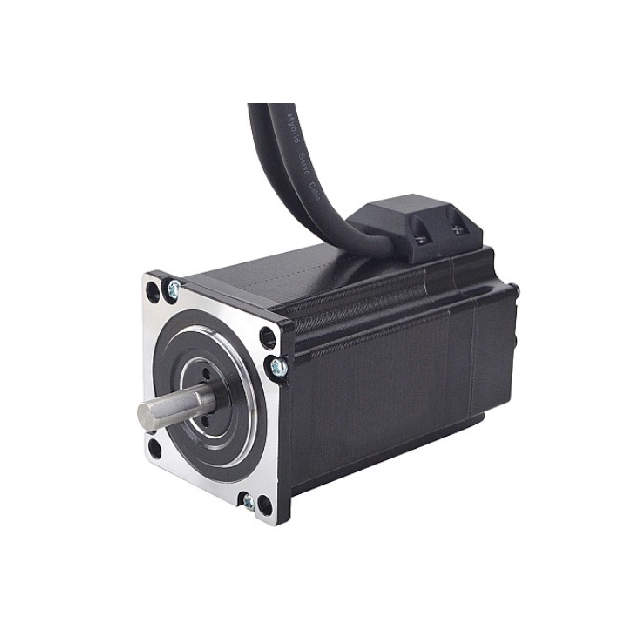
LM57HSN Series Closed-Loop Stepper Motor — High-Efficiency, Compact, and Smart Closed-Loop Motion Control Solution
Product Overview:The LEANMotor NEMA 23 LM57HSN Series Stepper Motor is designed for precision motion-control applications requiring reliable positioning, stable torque output, and consistent rotational performance. Featuring a standardized NEMA 23 frame size, this stepper motor offers convenient mechanical integration into various industrial automation systems and equipment.
With its step-by-step positioning capability and compact structural design, the LM57HSN30 is suitable for applications involving controlled rotation, repetitive positioning, and automated motion sequences. It can be integrated with compatible stepper motor drivers and motion controllers to achieve accurate speed and position control.
Key Technical Highlights
- Standard NEMA 23 Frame Size: Features an approximately 57 mm mounting-face dimension, facilitating integration into compatible industrial equipment and mechanical assemblies.
- Precise Positioning Capability: Stepper motor technology enables controlled incremental rotation, making it suitable for repetitive positioning and accurate motion-control tasks.
- Stable Torque Output: Designed to provide controlled rotational force for applications requiring reliable movement and positioning under appropriately selected mechanical loads.
- Flexible Drive Compatibility: Can be integrated with compatible stepper motor drivers and motion controllers to support different positioning, speed-control, and automation requirements.
- Versatile Mechanical Integration: Suitable for various transmission configurations, including couplings, gearboxes, lead screws, and belt-driven mechanisms, depending on the application design.
Typical Applications
The NEMA 23 LM57HSN30 stepper motor can be considered for a variety of industrial automation and precision motion-control applications, including:
1. CNC Machines: Driving lead screws and positioning mechanisms for controlled movement along machine axes.
2. 3D Printers: Controlling linear movement and positioning mechanisms to support accurate printing operations.
3. Laser Engraving and Cutting Machines: Providing controlled movement for positioning laser heads and worktables.
4. Automated Packaging Equipment: Driving feeding, conveying, indexing, and positioning mechanisms in packaging systems.
5. Industrial Automation Systems: Supporting repetitive positioning, rotary indexing, and synchronized mechanical movements in automated production equipment.
2. How Do Closed-Loop Stepper Motors Work in Agricultural Implement Height Adjustment Systems?
Closed-loop stepper motors combine a stepper motor, encoder, and motor driver to achieve precise positioning through real-time feedback. In autonomous agricultural tractors, they control electric lifting mechanisms by converting movement commands into accurate mechanical displacement.
Unlike open-loop stepper motors, closed-loop systems monitor actual motor movement and detect positioning errors, helping maintain reliable implement height adjustment under changing operating conditions.
2.1 Stepper Motor Positioning Control
The motor receives pulse and direction signals from the controller to determine its rotation direction, speed, and movement distance.
In agricultural implement adjustment systems, motor rotation can drive:
Lead screw lifting mechanisms.
Ball screw positioning assemblies.
Gear-driven lifting systems.
Belt-driven adjustment mechanisms.
Electric linear actuators.
These mechanisms convert rotary motion into linear movement, allowing the tractor to raise or lower agricultural implements to the required height.
2.2 Encoder Feedback for Position Monitoring
An encoder continuously monitors the actual rotation of the motor shaft and sends feedback to the driver.
The system compares the commanded position with the actual motor position. If a deviation occurs due to excessive resistance or changing mechanical loads, the controller can detect the error and initiate corrective action.
This feedback mechanism helps prevent undetected positioning errors and improves adjustment repeatability.
2.3 Real-Time Motion Correction
Agricultural implements experience changing loads when operating across different soil conditions and uneven terrain.
Closed-loop stepper motors use encoder feedback to monitor movement deviations and adjust motor operation accordingly.
Key functions include:
Position error detection: Identifies differences between commanded and actual motor positions.
Stall detection: Detects abnormal motor operation.
Speed control: Regulates motor speed during lifting and lowering.
Overload protection: Helps protect the motor and drive system.
Position holding: Maintains the required position when supported by the motor and mechanical transmission.
By combining these functions, closed-loop stepper motors provide more reliable positioning control for autonomous agricultural tractor implement height adjustment systems.
3. How Do Closed-Loop Stepper Motors Improve Implement Height Adjustment Accuracy?
Positioning accuracy is one of the primary considerations when selecting motors for autonomous agricultural machinery.
Implement height adjustment requires repeatable movement, controlled stopping positions, and reliable operation under changing mechanical loads.
Closed-loop stepper motors improve these capabilities in several ways.
3.1 Reducing Positioning Errors
Open-loop stepper systems calculate movement based on commanded pulses. However, excessive mechanical resistance, sudden load changes, or insufficient motor torque may cause missed steps.
When missed steps occur, the actual motor position may no longer correspond to the controller's estimated position.
Closed-loop stepper motors address this limitation through encoder feedback.
By monitoring actual shaft movement, the controller can identify positioning discrepancies and respond accordingly.
This is particularly useful when agricultural implements must repeatedly move between predefined operating heights.
3.2 Improving Repeatability During Repeated Operations
Autonomous tractors often perform repetitive operations across large agricultural fields.
For example, a tractor may repeatedly raise its cultivator when turning at field boundaries and lower it when returning to the working area.
If the lifting mechanism cannot reproduce the same target positions consistently, implement operation may become uneven.
Closed-loop stepper motors provide feedback-based positioning that helps the system return to previously established positions.
This supports more consistent implement movement during repeated agricultural cycles.
3.3 Maintaining Position Under Changing Mechanical Loads
The load applied to an implement lifting mechanism can vary depending on implement weight, transmission friction, mechanical geometry, and external forces.
A properly sized closed-loop stepper motor can provide controlled positioning while monitoring whether actual movement follows the commanded trajectory.
However, motor selection remains essential. The motor must provide sufficient torque throughout the required speed range, including the additional torque needed for acceleration and load disturbances.
For heavy agricultural implements, the complete lifting mechanism must also be designed with suitable mechanical support and load-holding components.
4. Applications of Closed-Loop Stepper Motors in Autonomous Agricultural Tractor Implements
Closed-loop stepper motors can support multiple electric adjustment mechanisms in autonomous agricultural tractors.
Their suitability depends on implement weight, required travel distance, operating speed, environmental conditions, and mechanical transmission design.
4.1 Seed Drill Height and Depth Adjustment
Seed drills require consistent planting depth to support uniform seed germination and crop development.
If the planting equipment operates too deeply, seeds may experience delayed emergence. If it operates too shallowly, seeds may become exposed to unfavorable environmental conditions.
Closed-loop stepper motors can drive electric screw adjustment mechanisms that control the vertical position of selected seed drill components.
By receiving positioning commands from the tractor's control system, the motor can adjust the mechanism to predetermined settings.
Encoder feedback helps verify that the motor has reached the commanded position.
When combined with suitable ground sensors and implement control algorithms, this arrangement can support more consistent planting depth management.
4.2 Cultivator Working Height Adjustment
Cultivators must maintain appropriate working depths to achieve effective weed control and soil cultivation.
Different soil conditions may require different penetration depths. Excessive penetration increases draft resistance and energy consumption, while insufficient penetration can reduce cultivation effectiveness.
Closed-loop stepper motors can drive lead screw or gear-based electric lifting mechanisms to adjust cultivator height.
For example, the autonomous tractor controller can establish a target position according to the selected cultivation mode.
The motor executes the movement while encoder feedback monitors actual rotation.
This arrangement helps improve the repeatability of implement height adjustments and supports automated switching between working and transport positions.
4.3 Rotary Tiller Height Adjustment
Rotary tillers require controlled working depth to achieve uniform soil preparation.
Their operating loads can change considerably depending on soil hardness, moisture, and working depth.
An electric lifting mechanism driven by a properly selected closed-loop stepper motor can provide controlled adjustment of the tiller's relative position.
The encoder helps monitor motor movement during lifting and lowering operations.
For applications involving heavier tillers, the mechanical transmission must provide sufficient load capacity. A self-locking screw mechanism, mechanical brake, or independent locking structure may also be necessary to prevent unintended movement when the motor is not actively driving the load.
4.4 Fertilizer Applicator Height Adjustment
Fertilizer applicators require appropriate positioning to achieve consistent fertilizer placement.
Depending on the application method, the working height of distribution components can influence material placement and application uniformity.
Closed-loop stepper motors can be integrated into electric adjustment assemblies to control the position of selected fertilizer application components.
Their programmable positioning capability supports multiple operating configurations.
When integrated with the tractor's electronic control system, the motor can execute predefined adjustment commands based on the selected field operation.
4.5 Sprayer Boom Height Adjustment
Sprayer boom height directly influences spraying coverage and droplet distribution.
If the boom operates too high, spray drift may increase. If it operates too low, the boom may contact crops or experience mechanical damage when crossing uneven terrain.
Closed-loop stepper motors can drive compatible electric boom positioning mechanisms, allowing controlled vertical adjustment.
When combined with ultrasonic or other distance sensors, the tractor's control system can calculate the required height correction and command the motor to move the boom accordingly.
For large or heavily loaded spraying booms, the motor and transmission must be carefully selected according to the lifting force, structural dimensions, and dynamic operating requirements.
5. Closed-Loop Stepper Motors vs. Open-Loop Stepper Motors for Agricultural Height Adjustment
Both open-loop and closed-loop stepper motors can be used in agricultural machinery. However, their control capabilities differ.
Comparison
Open-Loop Stepper Motor
Closed-Loop Stepper Motor
Position feedback
Generally unavailable
Encoder feedback
Position deviation detection
Limited
Supported
Missed-step monitoring
Not inherently available
Supported through feedback
Load adaptability
Depends on torque margin
Feedback-based response
Positioning reliability
Depends on commanded movement and load conditions
Improved through position verification
System complexity
Relatively simple
Higher
Typical applications
Basic positioning mechanisms
More demanding positioning applications
For autonomous agricultural tractors, closed-loop stepper motors offer an important advantage when implement positioning must be monitored rather than simply commanded.
Nevertheless, they do not eliminate every mechanical or control limitation. Accurate performance still depends on proper motor sizing, transmission design, encoder resolution, controller configuration, and sensor integration.
6. Integrating Closed-Loop Stepper Motors with Autonomous Tractor Control Systems
A closed-loop stepper motor does not operate independently of the agricultural machine's overall automation architecture.
To achieve reliable implement height adjustment, we need to coordinate motor control, position sensing, mechanical transmission, and the tractor's central controller.
A typical system includes the following components.
6.1 Central Agricultural Control Unit
The central controller processes operating commands and determines the required implement position.
Depending on the tractor's automation architecture, the controller may receive information from:
GPS and GNSS positioning systems.
Ultrasonic distance sensors.
Inertial measurement units.
Ground-following sensors.
Implement position sensors.
Operator-defined working parameters.
Based on this information, the controller generates movement commands for the motor drive.
6.2 Closed-Loop Stepper Motor and Driver
The motor and driver execute the required positioning movement.
The controller sends pulse and direction signals or communicates through a supported industrial interface, depending on the selected drive configuration.
The motor encoder provides position feedback to the driver, enabling it to monitor actual movement and manage position corrections.
6.3 Mechanical Lifting Transmission
The transmission converts motor rotation into linear movement.
Common solutions include lead screws, ball screws, gears, and belt-driven mechanisms.
For agricultural applications, the transmission should provide sufficient mechanical strength, suitable travel distance, and resistance to vibration and contamination.
6.4 Position and Safety Monitoring
Motor encoder feedback verifies motor shaft movement, but it does not automatically confirm the absolute position of the implement.
Transmission backlash, coupling failure, structural deformation, or mechanical slippage may cause the implement position to differ from the motor's calculated position.
Therefore, we recommend integrating an independent linear position sensor when accurate implement-to-ground positioning is essential.
Limit switches and mechanical stops can provide additional protection against excessive travel.
7. Key Factors When Selecting Closed-Loop Stepper Motors for Agricultural Implement Adjustment
Selecting the right closed-loop stepper motor is essential for ensuring accurate positioning, stable operation, and long-term reliability in agricultural implement height adjustment systems. We need to consider the implement's weight, required lifting force, positioning accuracy, installation space, and environmental conditions.
7.1 Required Torque and Implement Weight
The motor must generate sufficient torque to lift the agricultural implement and overcome mechanical resistance. We should calculate the required lifting force based on implement weight, transmission structure, friction, and acceleration requirements.
We should also consider dynamic loads and maintain an appropriate safety margin to prevent motor overload.
7.2 Motor Size and Installation Space
Agricultural machinery often has limited installation space. Therefore, we should select a motor according to the available mounting dimensions, flange size, shaft configuration, and required torque.
Common options include NEMA 17, NEMA 23, and NEMA 34 closed-loop stepper motors. Smaller motors are suitable for compact adjustment mechanisms, while larger models can provide higher torque for more demanding applications.
7.3 Encoder Resolution and Positioning Accuracy
Encoder resolution determines how precisely the motor shaft position can be monitored.
For agricultural implement height adjustment, appropriate encoder resolution helps improve positioning repeatability and detect movement deviations.
However, actual positioning accuracy also depends on transmission backlash, screw lead, mechanical rigidity, and controller performance.
7.4 Environmental Protection
Agricultural tractors operate in demanding outdoor environments. Motors may be exposed to dust, moisture, vibration, fertilizer residue, and temperature fluctuations.
We should evaluate the motor's IP protection rating, operating temperature range, connector sealing, and vibration resistance to ensure reliable operation.
7.5 Communication and Control Compatibility
The motor driver must communicate effectively with the autonomous tractor's control system.
Depending on the application, available control interfaces may include:
Pulse and direction signals.
RS485 communication.
CANopen communication.
Other supported industrial interfaces.
Selecting a compatible control interface simplifies system integration and allows the motor to receive positioning commands from the tractor's central controller.
By evaluating these five factors, we can select a closed-loop stepper motor that meets the lifting force, positioning accuracy, installation, and environmental requirements of agricultural implement adjustment systems.
8. Why Are Integrated Closed-Loop Stepper Motors Worth Considering?
For agricultural equipment manufacturers, installation space, wiring complexity, and maintenance requirements are important design considerations.
An integrated closed-loop stepper motor combines the motor, encoder, and driver into a compact assembly.
This configuration can simplify the design of electric implement height adjustment systems.
8.1 Simplified System Installation
Traditional motor systems may require separate mounting arrangements for the motor, encoder, and driver.
Integrated designs consolidate these components, reducing the number of separate devices that need to be installed.
This can simplify wiring and help equipment manufacturers optimize the internal layout of agricultural machinery.
8.2 Reduced Wiring Complexity
Integrating the motor and driver can reduce certain external connections.
Fewer separate components may also simplify cable routing and improve the overall organization of the electrical control system.
This is particularly beneficial when multiple electric adjustment mechanisms are installed on the same autonomous tractor.
8.3 Compact Mechanical Design
Agricultural implements often have limited installation space.
Integrated closed-loop stepper motors provide a compact solution for applications where the motor and drive electronics need to be installed close to the lifting mechanism.
However, thermal management and environmental protection must still be considered during installation.
8.4 Convenient Parameter Configuration
Depending on the model, integrated closed-loop stepper motors may support configurable current, acceleration, speed, position, and protection parameters.
These functions allow manufacturers to adapt motor behavior to different implement adjustment requirements.
For equipment manufacturers developing multiple agricultural machinery models, standardized integrated motor platforms can also simplify product development and electrical integration.
9. Future Development of Intelligent Implement Height Adjustment in Autonomous Agriculture
With the development of precision agriculture and autonomous farming technologies, agricultural tractors are increasingly adopting intelligent control systems to improve operational accuracy and efficiency. Intelligent implement height adjustment will become an important part of future agricultural automation, allowing tractors to automatically adapt implement positions to changing terrain and working conditions.
Closed-loop stepper motors can support this development by providing precise positioning, encoder feedback, and reliable electric motion control.
9.1 Integration with Intelligent Sensors
Future autonomous tractors will increasingly integrate GNSS, ultrasonic sensors, LiDAR, and terrain detection systems to monitor field conditions.
These sensors can provide real-time information about ground elevation and implement position. The central controller then sends adjustment commands to closed-loop stepper motors, allowing agricultural implements to maintain the required working height.
9.2 Adaptive Height Adjustment
Traditional adjustment systems often rely on predefined working positions. Intelligent systems can use real-time sensor information to automatically adjust implement height according to changing soil conditions and terrain.
With encoder feedback, closed-loop stepper motors can monitor actual movement and execute more consistent positioning adjustments.
This helps improve working depth consistency and reduce unnecessary mechanical movement.
9.3 Multi-Axis Synchronized Motion Control
Some agricultural implements require simultaneous adjustment along multiple axes. For example, large spraying booms and advanced cultivation equipment may need coordinated vertical and horizontal positioning.
Multiple closed-loop stepper motors can work together through a central controller to achieve synchronized movement.
This improves positioning coordination and supports more flexible agricultural equipment designs.
9.4 Predictive Maintenance and Intelligent Monitoring
Future motor control systems may integrate operating data such as position deviations, motor current, temperature, and operating cycles.
By analyzing these parameters, equipment manufacturers can identify abnormal operating conditions and potential mechanical problems earlier.
This can help reduce unexpected downtime and improve agricultural machinery maintenance efficiency.
9.5 Development of Compact Integrated Motor Solutions
As autonomous agricultural machinery becomes more compact and electronically integrated, manufacturers will increasingly value motors that simplify installation and wiring.
Integrated closed-loop stepper motors, combining the motor, encoder, and driver, offer a practical solution for suitable electric implement adjustment mechanisms.
Their compact structure can reduce separate components and simplify system integration.
Overall, the future of intelligent agricultural implement height adjustment will depend on the combination of sensor technology, automated control algorithms, and reliable motion-control components. Closed-loop stepper motors will continue to play an important role in electric positioning applications that require accurate, repeatable, and intelligent movement control.
10. Conclusion: Improving Agricultural Implement Positioning with Closed-Loop Stepper Motors
Accurate implement height adjustment is an important requirement for autonomous agricultural tractors. It influences planting depth, cultivation quality, fertilizer placement, spraying performance, and overall field operation consistency.
Closed-loop stepper motors improve electric implement adjustment systems by combining precise stepper motor movement with encoder-based position feedback. Their ability to monitor actual shaft movement, identify positioning deviations, and support corrective control makes them valuable for agricultural machinery requiring repeatable positioning.
From seed drills and cultivators to rotary tillers, fertilizer applicators, and spraying equipment, these motors can support a wide range of automated adjustment mechanisms.
For agricultural equipment manufacturers, selecting the right motor requires evaluating torque, speed, encoder resolution, transmission efficiency, installation dimensions, environmental protection, and control compatibility.
By combining appropriately selected closed-loop stepper motors with suitable mechanical transmissions and intelligent sensor systems, we can develop more reliable and adaptable electric implement height adjustment solutions for next-generation autonomous agricultural tractors.
FAQS:
1. How do closed-loop stepper motors improve implement height adjustment in autonomous agricultural tractors?
Closed-loop stepper motors improve implement height adjustment by combining precise stepper motor movement with encoder feedback. They monitor actual motor position, detect deviations, and support corrective movement when positioning errors occur. This helps autonomous tractors achieve more consistent lifting and lowering operations under changing agricultural working conditions.
2. Why are closed-loop stepper motors better than open-loop stepper motors for agricultural implement positioning?
Closed-loop stepper motors provide encoder feedback to monitor actual motor movement, while open-loop stepper motors generally rely on commanded pulse signals without independently verifying shaft position. This allows closed-loop systems to detect missed steps and positioning deviations, making them suitable for agricultural applications requiring reliable and repeatable implement adjustment.
3. Can closed-loop stepper motors control the lifting height of agricultural implements?
Yes. Closed-loop stepper motors can drive electric lifting mechanisms using lead screws, ball screws, gears, or belt transmissions. These mechanisms convert motor rotation into linear movement, allowing agricultural implements such as cultivators, seed drills, and fertilizer applicators to move between predefined working and transport positions.
4. How does encoder feedback improve positioning accuracy in agricultural machinery?
An encoder monitors the actual rotation of the motor shaft and sends feedback to the motor driver. The controller compares actual movement with the commanded position and detects deviations. This feedback helps maintain positioning accuracy and repeatability during implement lifting, lowering, and height adjustment operations.
5. Which agricultural implements can use closed-loop stepper motors for height adjustment?
Closed-loop stepper motors can be integrated into electric adjustment mechanisms for various agricultural implements, including seed drills, cultivators, rotary tillers, fertilizer applicators, and sprayer booms. Their suitability depends on the implement's weight, required lifting force, adjustment speed, mechanical transmission, and environmental conditions.
6. How do closed-loop stepper motors handle changing loads during agricultural operations?
Closed-loop stepper motors use encoder feedback to monitor actual motor movement when mechanical loads change. If the motor experiences excessive resistance or positioning deviations, the driver can respond according to its control strategy. Proper torque selection, transmission design, and overload protection are essential for maintaining reliable operation.
7. What factors should be considered when selecting a closed-loop stepper motor for agricultural implement adjustment?
Important selection factors include holding torque, operating torque, speed, encoder resolution, motor frame size, transmission efficiency, installation dimensions, environmental protection, and communication compatibility. We should also calculate the required lifting force and consider dynamic loads to ensure the motor meets the application's operating requirements.
Yes. Integrated closed-loop stepper motors combine the motor, encoder, and driver into one compact assembly. This can reduce separate components, simplify wiring, save installation space, and make electrical integration easier for agricultural equipment manufacturers developing automated implement positioning systems.
9. Can closed-loop stepper motors work with sensors in intelligent agricultural height adjustment systems?
Yes. Closed-loop stepper motors can work with ultrasonic sensors, GNSS-based control systems, terrain detection sensors, and implement position sensors through a central controller. External sensors provide information about field conditions, while encoder feedback monitors motor movement to support automated implement height adjustment.
10. Are closed-loop stepper motors suitable for heavy-duty agricultural implement lifting systems?
Closed-loop stepper motors can be used in certain heavy-duty lifting applications when their torque, speed, and mechanical transmission capacity meet the requirements. However, very heavy implements may require hydraulic or servo-driven lifting solutions. Engineers should evaluate the actual lifting force, dynamic loads, duty cycle, and mechanical safety requirements before selecting a motor.