Home » News » What Causes Positioning Errors in Geared BLDC Motor-Driven Robots and How Can They Be Reduced?
What Causes Positioning Errors in Geared BLDC Motor-Driven Robots and How Can They Be Reduced?
Views: 0 Author: Site Editor Publish Time: 2026-06-11 Origin: Site
Modern robotic systems depend heavily on geared BLDC (Brushless DC) motors to achieve precise positioning, smooth motion control, and reliable operation. From collaborative robots and autonomous mobile robots to medical equipment and industrial automation systems, positioning accuracy directly affects productivity, safety, and product quality. However, even advanced robotic systems can experience positioning errors that reduce performance and compromise repeatability.
Understanding the root causes of positioning errors in geared BLDC motor-driven robots is essential for engineers, designers, and automation specialists seeking higher precision. By identifying mechanical, electrical, control-system, and environmental factors, it becomes possible to significantly improve robot positioning accuracy and long-term reliability.
Understanding Positioning Errors in Geared BLDC Motor Systems
Positioning error refers to the difference between the robot's commanded position and its actual position. In robotic applications, even minor deviations can accumulate over time, leading to inaccuracies in assembly operations, pick-and-place tasks, inspection processes, and precision manufacturing.
A geared BLDC motor system consists of multiple components, including:
Brushless DC motor
Gearbox or gear reducer
Encoder or feedback sensor
Motor driver
Motion controller
Mechanical transmission system
Any error generated within these components can contribute to overall positioning inaccuracies.
One of the most common causes of positioning errors is gear backlash.
Backlash refers to the small clearance between mating gear teeth. When the direction of rotation changes, this clearance creates a delay before torque is fully transferred to the output shaft.
Effects of backlash include:
Position overshoot
Direction reversal inaccuracies
Reduced repeatability
Poor low-speed positioning performance
Applications requiring frequent direction changes are particularly sensitive to backlash.
How to Reduce Backlash
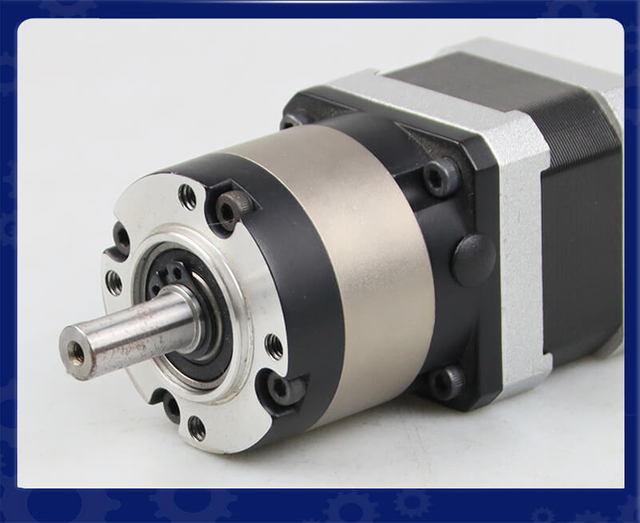
Use high-precision planetary gearboxes
Select low-backlash gear reducers
Implement backlash compensation algorithms
Maintain proper gear lubrication
Replace worn gearbox components regularly
Modern precision planetary gearboxes can reduce backlash to only a few arc minutes, significantly improving positioning performance.
Gear Wear and Mechanical Deformation
Over time, gears experience wear due to:
Friction
Shock loading
Continuous operation
Poor lubrication
As wear progresses, gear tooth geometry changes, increasing backlash and reducing transmission accuracy.
Mechanical deformation may also occur in:
Couplings
Shafts
Bearings
Structural frames
These deformations can introduce positional offsets and unpredictable motion behavior.
Prevention Methods
Use hardened steel gears
Conduct preventive maintenance
Monitor gearbox condition
Ensure proper load distribution
Avoid excessive shock loads
Bearing Clearance and Shaft Deflection
Bearing imperfections can generate small but significant positioning errors.
Factors include:
Bearing wear
Radial play
Axial movement
Shaft bending under load
High-torque robotic joints are especially vulnerable because increased loads amplify shaft deflection.
Solutions
Use precision-grade bearings
Increase shaft rigidity
Optimize mechanical support structures
Reduce excessive overhung loads
Encoder and Feedback System Errors
Encoder Resolution Limitations
Positioning accuracy depends heavily on encoder resolution. Low-resolution encoders provide less precise position feedback, which can lead to quantization errors, unstable positioning, and reduced motion accuracy.
How to Reduce It:
Use high-resolution encoders
Select absolute encoders for critical applications
Increase counts per revolution (CPR)
Match encoder resolution to application requirements
Encoder Mounting Errors
Incorrect encoder installation can cause feedback inaccuracies even when using high-quality encoders. Common issues include misalignment, loose mounting, shaft eccentricity, and vibration.
How to Reduce It:
Ensure proper encoder alignment
Use rigid mounting methods
Minimize shaft runout
Perform regular inspection and calibration
Accurate encoder selection and installation are essential for achieving reliable positioning and repeatability in geared BLDC motor-driven robotic systems.
Without proper compensation, load changes introduce positioning inaccuracies.
Compensation Strategies
Use adaptive control systems
Implement load estimation algorithms
Re-tune controllers for varying payloads
Select motors with sufficient torque reserves
Advanced Techniques for Reducing Positioning Errors
As robotic systems become more sophisticated, achieving high positioning accuracy requires more than just selecting quality motors and gearboxes. Advanced control strategies, feedback technologies, and predictive maintenance methods can significantly reduce positioning errors and improve overall system performance.
Implement Closed-Loop Control Systems
Closed-loop control continuously compares the commanded position with the actual position and automatically corrects deviations in real time.
Key benefits include:
Improved positioning accuracy
Faster error correction
Better repeatability
Enhanced dynamic response
Reduced sensitivity to load changes
By integrating high-resolution encoders and intelligent motor drivers, closed-loop geared BLDC motor systems can maintain precise positioning even under varying operating conditions.
Use Dual Encoder Feedback
In high-precision robotic applications, a single encoder may not be sufficient to detect all transmission-related errors.
A dual encoder system typically includes:
A motor-side encoder
An output-side encoder
This configuration allows the controller to monitor both motor rotation and actual output shaft position, helping compensate for:
Gear backlash
Gearbox elasticity
Mechanical compliance
Transmission inaccuracies
Dual feedback systems are commonly used in precision robotic arms, semiconductor equipment, and medical automation devices.
Apply Backlash Compensation Algorithms
Even low-backlash gearboxes can introduce minor positioning errors during direction changes.
Modern motion controllers can compensate for these errors by:
Detecting motion reversal
Predicting gearbox clearance
Automatically adjusting command positions
Backlash compensation improves positioning consistency without requiring major mechanical modifications.
Optimize Motion Profiles
Aggressive acceleration and deceleration can introduce vibration, overshoot, and tracking errors.
Optimized motion profiles help minimize these effects by:
Smoothing acceleration curves
Reducing mechanical shock
Limiting sudden direction changes
Improving path-following accuracy
S-curve motion profiles are often preferred over traditional trapezoidal profiles for precision robotic applications.
Utilize Feedforward Control
Feedforward control enhances traditional feedback systems by predicting required motor output before errors occur.
Advantages include:
Reduced tracking error
Faster response times
Improved trajectory accuracy
Better high-speed performance
When combined with PID control, feedforward algorithms can significantly improve robotic positioning precision.
Monitor and Compensate for Temperature Effects
Temperature changes can affect motor characteristics, gearbox dimensions, and encoder performance.
Advanced controllers can compensate for thermal effects by:
Monitoring component temperatures
Adjusting control parameters automatically
Correcting position offsets caused by thermal expansion
This approach helps maintain consistent positioning accuracy during long operating cycles.
Implement Predictive Maintenance
Mechanical wear gradually increases positioning errors over time.
Predictive maintenance systems monitor key indicators such as:
Vibration levels
Motor current consumption
Gearbox condition
Bearing performance
Operating temperature
By identifying early signs of wear, maintenance can be scheduled before accuracy is affected, reducing downtime and preserving system performance.
Leverage Advanced Communication Networks
High-speed industrial communication protocols improve synchronization and reduce control latency.
Common protocols include:
EtherCAT
CANopen
PROFINET
EtherNet/IP
These networks enable faster data exchange between controllers, drives, and feedback devices, resulting in more accurate and responsive motion control.
Improve Mechanical System Stiffness
Control algorithms alone cannot compensate for excessive mechanical flexibility.
Increasing system rigidity can reduce:
Shaft deflection
Structural vibration
Position drift
Dynamic positioning errors
Methods include using reinforced frames, precision bearings, and high-stiffness gearboxes designed for servo applications.
Combine Precision Hardware with Intelligent Control
The highest levels of positioning accuracy are achieved when advanced control techniques are paired with high-quality hardware components.
This integrated approach minimizes both static and dynamic positioning errors, ensuring reliable performance in demanding robotic applications.
Summary
Reducing positioning errors in geared BLDC motor-driven robots requires a combination of advanced control strategies, precision feedback systems, optimized motion profiles, and proactive maintenance practices. Technologies such as closed-loop control, dual encoder feedback, backlash compensation, feedforward control, and predictive diagnostics help robotic systems achieve higher accuracy, improved repeatability, and greater operational reliability in precision automation environments.
Selecting the Right Geared BLDC Motor for Precision Robotics
Choosing the right geared BLDC motor is one of the most important factors in achieving accurate positioning, smooth motion, and reliable robotic performance. A well-matched motor and gearbox combination can significantly improve precision, repeatability, and system efficiency while reducing maintenance requirements.
Prioritize Low-Backlash Gearboxes
Backlash is a major source of positioning error in robotic systems. Excessive gearbox backlash can cause delayed response, inaccurate direction changes, and reduced repeatability.
When selecting a geared BLDC motor, consider:
Low-backlash planetary gearboxes
Precision-machined gear sets
High torsional stiffness
Gearboxes designed for servo applications
For robotic joints and end-effectors, lower backlash generally results in better positioning accuracy and smoother motion control.
Choose the Appropriate Gear Ratio
The gearbox ratio directly influences torque, speed, and positioning performance.
A higher gear ratio can provide:
Increased output torque
Improved load-carrying capability
Better low-speed control
A lower gear ratio can provide:
Faster movement speeds
Higher dynamic response
Reduced transmission losses
The optimal ratio depends on the robot's payload, speed requirements, and accuracy targets.
Select High-Resolution Encoder Feedback
Encoder feedback plays a critical role in maintaining accurate positioning.
Important encoder considerations include:
Incremental or absolute encoder type
Encoder resolution
Signal reliability
Environmental resistance
Higher-resolution encoders allow the controller to detect smaller position changes, improving overall system precision and repeatability.
Evaluate Torque Requirements Carefully
Robotic applications often experience changing loads and dynamic operating conditions.
The selected geared BLDC motor should provide:
Sufficient continuous torque
Adequate peak torque
Safety margin for unexpected loads
Stable torque output throughout the operating range
Undersized motors can lead to positioning errors, overheating, and reduced service life.
Consider Motion Control Compatibility
A geared BLDC motor should integrate seamlessly with the robot's control architecture.
Look for compatibility with:
Pulse and Direction control
CANopen communication
EtherCAT networks
RS485 communication
Closed-loop servo control systems
Advanced communication protocols enable faster feedback processing and more accurate motion control.
These applications require consistent positioning, smooth motion, and dependable operation.
Key Selection Checklist
Before selecting a geared BLDC motor, verify the following:
Selection Factor
Importance
Low Backlash Gearbox
High
Encoder Resolution
High
Torque Capacity
High
Control Compatibility
High
Thermal Performance
Medium
Mechanical Rigidity
High
Service Life
High
Environmental Protection
Medium
Final
The right geared BLDC motor for precision robotics combines a low-backlash gearbox, high-resolution encoder, adequate torque capacity, robust mechanical design, and advanced motion control compatibility. Careful selection of these factors helps minimize positioning errors, improve repeatability, and ensure reliable robotic performance in demanding automation applications.
Conclusion
Positioning errors in geared BLDC motor-driven robots originate from a combination of mechanical, electrical, control-system, and environmental factors. Gear backlash, encoder limitations, control loop latency, torque ripple, thermal effects, vibration, and load variations all contribute to deviations between commanded and actual positions. By integrating low-backlash gearboxes, high-resolution encoders, advanced control algorithms, robust mechanical designs, and predictive maintenance strategies, robotic systems can achieve substantially higher positioning accuracy, repeatability, and operational reliability. Precision-engineered geared BLDC motor solutions remain one of the most effective foundations for modern robotic motion control systems where accuracy and efficiency are critical requirements.
BesFoc provides precision geared BLDC motor solutions designed for robotics, automation equipment, AGVs, AMRs, medical devices, and industrial motion control systems. With low-backlash gearboxes, high-efficiency brushless motors, integrated encoders, and advanced control options, BesFoc helps engineers achieve accurate positioning, reliable performance, and long-term operational stability in demanding applications.